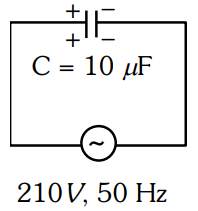
A 10 μF capacitor is connected to a 210 V, 50 Hz source as shown in figure. The peak current in the circuit is nearly (π = 3.14) :
Solution :
The circuit consists of a single capacitor \(C = 10\;\mu\text{F}\) connected to an AC source that supplies a sinusoidal voltage with an RMS value of \(V_{\text{rms}} = 210\;\text{V}\) at a frequency of \(f = 50\;\text{Hz}\) (as shown in the provided figure).
1. **Find the angular frequency \(\omega\)**
\[
\omega = 2\pi f
\]
Substituting \(f = 50\;\text{Hz}\):
\[
\omega = 2 \times 3.14 \times 50 = 314\;\text{rad/s}
\]
2. **Calculate the capacitive reactance \(X_C\)**
\[
X_C = \frac{1}{\omega C}
\]
Convert the capacitance to farads: \(C = 10\;\mu\text{F} = 10 \times 10^{-6}\;\text{F}\).
\[
X_C = \frac{1}{314 \times 10 \times 10^{-6}} = \frac{1}{3.14 \times 10^{-3}} \approx 318.5\;\Omega
\]
3. **Determine the peak (maximum) source voltage \(V_{\text{peak}}\)**
The given 210 V is an RMS value, so the peak value is:
\[
V_{\text{peak}} = \sqrt{2}\; V_{\text{rms}} = 1.414 \times 210 \approx 296.9\;\text{V}
\]
4. **Compute the peak current \(I_{\text{peak}}\)** using Ohm’s law for the reactive circuit:
\[
I_{\text{peak}} = \frac{V_{\text{peak}}}{X_C}
\]
\[
I_{\text{peak}} = \frac{296.9\;\text{V}}{318.5\;\Omega} \approx 0.933\;\text{A}
\]
5. **Round to the appropriate number of significant figures** – the answer is given to two decimal places, yielding \(0.93\;\text{A}\).
Hence, the peak current in the circuit is **0.93 A**, which matches the correct option provided.
Completely free for students. Educators & coaching institutes get 2 months free Pro trial to create tests.
Access unlimited practice questions, detailed step-by-step solutions, and exam study materials — completely free for students.
Create and conduct professional online assessments with AI question generation, tab proctoring, and comprehensive batch management.

A comprehensive JEE Advanced 2022 Paper 1 designed to help aspirants understand the examination pattern, difficulty level, and question trends of JEE Advanced. This paper covers important concepts from Physics, Chemistry, and Mathematics, featuring a balanced mix of conceptual, numerical, and advanced application-based questions. It helps students strengthen conceptual understanding, enhance analytical and problem-solving skills, and improve speed and accuracy. Ideal for practice, revision, self-assessment, previous year trend analysis, concept reinforcement, and time management, this paper is a valuable resource for effective JEE Advanced preparation.

A comprehensive JEE Advanced 2022 Paper 2 designed to help aspirants understand the examination pattern, difficulty level, and question trends of JEE Advanced. This paper covers important concepts from Physics, Chemistry, and Mathematics, featuring a balanced mix of conceptual, numerical, and advanced application-based questions. It helps students strengthen conceptual understanding, enhance analytical and problem-solving skills, and improve speed and accuracy. Ideal for practice, revision, self-assessment, previous year trend analysis, concept reinforcement, and time management, this paper is a valuable resource for effective JEE Advanced preparation.
Copyright © 2026 Combe Labs Private Limited. All Rights Reserved.