A 200 mm wide plate having a thickness of 20 mm is fed through a rolling mill with two rolls. The radius of each roll is 300 mm. The plate thickness is to be reduced to 18 mm in one pass using a roll speed of 50 rpm. The strength coefficient (K) of the work material flow curve is 300 MPa and the strain hardening exponent, n is 0.2. The coefficient of friction between the rolls and the plate is 0.1. If the friction is sufficient to permit the rolling operation then the roll force will be _____________kN (round off to the nearest integer)
Correct Answer :
Correct answer is : 930
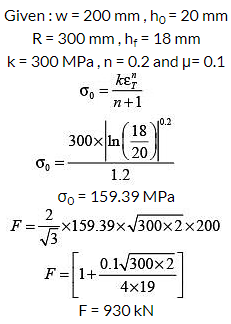
Solution :
The correct answer is 930.
To determine the roll force required for the rolling operation, we analyze the parameters given in the problem statement and the attached image:
- Plate width,
- Initial plate thickness,
- Final plate thickness,
- Roll radius,
- Strength coefficient,
- Strain hardening exponent,
- Coefficient of friction,
Step 1: Calculate the true strain ()
The true strain is determined by the deformation in thickness:
Step 2: Calculate the average flow stress ()
The average flow stress is computed using the material's flow curve equation:
Substituting the given values:
Step 3: Calculate the contact length () and average thickness ()
The projected length of the roll-plate contact arc () is:
The average thickness of the plate () during the pass is:
Step 4: Calculate the roll force ()
Assuming plane strain conditions during rolling, the roll force is given by the formula:
Substituting the calculated values into the expression:
Evaluating each term step-by-step:
Rounding to the nearest integer, the roll force is 930 kN.
Access expert-curated educational resources and study materials—completely free.
Create, conduct, and manage professional online assessments with Mindyard. Perfect for teachers and institutes.
Copyright © 2026 Mindyard. All Rights Reserved.