A 76.2 mm gauge block is used under one end of a 254 mm sine bar with roll diameter of 25.4 mm. The height of gauge blocks required at the other end of the sine bar to measure an angle of 30º is __________ mm (round off to two decimal places).
Correct Answer :
Correct answer is : 203.20
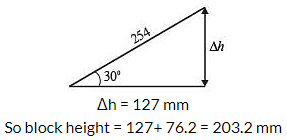
Solution :
The correct answer is 203.20.
Understanding the Sine Bar Setup:
A sine bar works on the trigonometric principle of a right-angled triangle. The distance between the centers of the two rollers (rolls) of the sine bar forms the hypotenuse (). The gauge blocks placed under the two ends of the sine bar create a height difference () which forms the perpendicular side of the triangle. The angle of inclination () is related to these values by the formula:
where:
- is the length of the sine bar (distance between roller centers) = 254 mm.
- is the required angle = 30º.
- is the difference in height between the two ends of the sine bar.
Visualizing the Schematic from the Image:
The provided diagram illustrates a right-angled triangle representing the setup of the sine bar. The hypotenuse is labeled with a length of 254, the base angle is labeled as 30º, and the perpendicular vertical side represents the height difference, labeled as . Below the diagram, the text reads:
and calculates the total height as:
Step-by-Step Mathematical Derivation:
1. First, we calculate the required height difference () using the sine relationship:
Substituting the given parameters:
Since :
2. Determine the height of the gauge blocks at the elevated end ():
Let be the height of the gauge blocks under the first end (). The difference in height is given by:
Rearranging to solve for :
Substituting the values yields:
Thus, rounding off to two decimal places, the height of the gauge blocks required at the other end is 203.20 mm.
Access expert-curated educational resources and study materials—completely free.
Create, conduct, and manage professional online assessments with Mindyard. Perfect for teachers and institutes.
Copyright © 2026 Mindyard. All Rights Reserved.