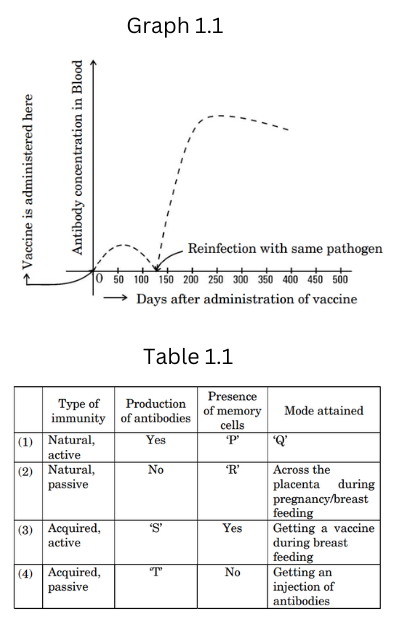
(a) A time-bound vaccination programme is followed for the children in our country from their birth up to ten years of age. A graph plotted below (Graph 1.1) shows the effect of the vaccination followed by infection by the same pathogen, and the antibody concentration in the blood of the child.
i) Explain why the administration of a vaccine causes an increase in the antibody concentration.
ii) If the child is infected with the same pathogen almost four months later, the antibody concentration in his/her blood increases very fast. Explain why.
iii) A table given below gives information about different types of immunity and how they are attained. Identify P , Q , R , S and T in the table (Table 1.1)
or
(b)
i) What is the chemical name of 'smack' ? Why is the consumption of smack considered as an abuse ?
ii) Name the source plant and one effect of the following drugs on the human body :
1. Marijuana
2. Cocaine
3. Morphine
Correct Answer :
(a)
i) The vaccine contains the antigen, which stimulates or activates immune cells to produce antibodies (by B lymphocytes) / which generates primary response or humoral immune response.
ii) Memory cells generate, amnestic response/secondary response
iii) P = Yes Q = Catching an infection/getting infected R = No S = Yes T = No
or
(b)
i)
• Diacetylmorphine
• as it is highly addictive, and being a depressant it slows down body functions.
ii)
1. Cannabis sativa, affects the cardiovascular system of the body.
2.Erythroxylum coca /coca plant , interferes with the transport of neurotransmitter dopamine / produces sense of euphoria / increased energy.
3. Papaver somniferum, acts as depressant/ slows down body function/ reduces pain/sedative
Solution :
Correct Answer / Option:
(a)
i) The vaccine contains the antigen, which stimulates or activates immune cells to produce antibodies (by B lymphocytes) / which generates primary response or humoral immune response.
ii) Memory cells generate, amnestic response/secondary response
iii) P = Yes, Q = Catching an infection/getting infected, R = No, S = Yes, T = No
or
(b)
i) Chemical name of 'smack': Diacetylmorphine.
It is considered an abuse because it is highly addictive, and being a depressant it slows down body functions.
ii)
1. Marijuana: Source plant is Cannabis sativa; effect is that it affects the cardiovascular system of the body.
2. Cocaine: Source plant is Erythroxylum coca (coca plant); effect is that it interferes with the transport of neurotransmitter dopamine, producing a sense of euphoria and increased energy.
3. Morphine: Source plant is Papaver somniferum; effect is that it acts as a depressant, slows down body function, reduces pain, and acts as a sedative.
---
Step-by-Step Educational Explanation:
Part (a) Analysis:
i) Mechanism of Vaccination:
Vaccines contain weakened, dead, or inactive pathogens, or their antigenic proteins. In Graph 1.1, when the vaccine is administered at day 0, these antigens are introduced into the body. While they do not cause disease, they act as foreign agents that stimulate the immune system. Specifically, they activate B-lymphocytes (B cells) to differentiate into plasma cells, which produce specific antibodies against the antigen. This initial response is called the primary immune response, which is characterized by a slow and low-intensity rise in antibody concentration in the blood, as seen in the small curve between days 0 and 100.
ii) Secondary (Anamnestic) Response:
As observed in Graph 1.1, when the child is reinfected with the same pathogen around day 130 (almost four months later), the antibody concentration rises extremely rapidly and reaches a much higher peak. This is because the primary response generated specialized memory B cells and memory T cells that persist in the body for a long time. Upon subsequent exposure to the same pathogen, these memory cells immediately recognize the antigen and rapidly proliferate into antibody-producing plasma cells. This leads to a highly intensified secondary (anamnestic) response, which quickly neutralizes the pathogen before it can cause illness.
iii) Identification of P, Q, R, S, and T in Table 1.1:
Let us evaluate each row of the table systematically:
• Row (1) - Natural Active Immunity: This is achieved naturally when a person catches an infection (Q = Catching an infection / getting infected). Because the body active fights off the pathogen using its own immune system, memory cells are generated (P = Yes).
• Row (2) - Natural Passive Immunity: This is attained naturally when pre-formed antibodies are transferred (e.g., IgG across the placenta or IgA through breast milk). Since the host's own immune cells are not actively engaged, no memory cells are created (R = No).
• Row (3) - Acquired Active Immunity: This is achieved artificially by vaccination. Active immunity, by definition, involves the host's body actively producing its own antibodies in response to the vaccine antigens. Hence, antibody production is active (S = Yes).
• Row (4) - Acquired Passive Immunity: This is attained by directly injecting ready-made antibodies (e.g., anti-tetanus serum). Since the antibodies are introduced from outside and not produced by the individual's immune system, there is no active antibody production by the host (T = No).
---
Part (b) Analysis:
i) Smack:
Smack is chemically known as diacetylmorphine (commonly known as heroin). It is obtained by the acetylation of morphine. Consuming smack is classified as drug abuse because it has a very high potential for addiction and physical dependence. Physiologically, it acts as a central nervous system depressant, slowing down heart rate, respiration, and general bodily metabolic functions.
ii) Drug Sources and Effects:
1. Marijuana:
• Source Plant: Cannabinoids are obtained from the inflorescences of the plant Cannabis sativa.
• Effect: It primarily interacts with cannabinoid receptors in the brain and affects the cardiovascular system of the body (causing increased heart rate and blood pressure fluctuations).
2. Cocaine:
• Source Plant: It is an alkaloid extracted from the coca plant, Erythroxylum coca, native to South America.
• Effect: It interferes with the transport of the neurotransmitter dopamine in the brain. It has a potent stimulating action on the central nervous system, producing a temporary sense of euphoria, increased energy, and alertness.
3. Morphine:
• Source Plant: It is extracted from the latex of the poppy plant, Papaver somniferum.
• Effect: It is a strong analgesic (pain killer) and sedative. It acts as a depressant that slows down central nervous system activity, helping patients undergo surgery or manage severe trauma by reducing pain sensation and inducing sleep.
Access expert-curated educational resources and study materials—completely free.
Create, conduct, and manage professional online assessments with Mindyard. Perfect for teachers and institutes.
Copyright © 2026 Mindyard. All Rights Reserved.
 Set - 3-1782888548748.webp)