(a) A time-bound vaccination programme is followed for the children in our country from their birth up to ten years of age. A graph plotted below shows the effect of the vaccination followed by infection by the same pathogen, and the antibody concentration in the blood of the child.
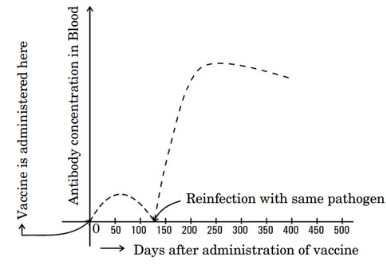
i) Explain why the administration of a vaccine causes an increase in the antibody concentration.
ii) If the child is infected with the same pathogen almost four months later, the antibody concentration in his/her blood increases very fast. Explain why.
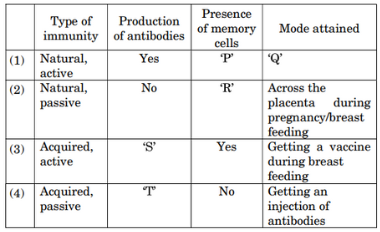
iii) A table given below gives information about different types of immunity and how they are attained. Identify P, Q, R, Sand T in the table.
or
(b)
i) What is the chemical name of 'smack' ? Why is the consumption of smack considered as an abuse ?
ii) Name the source plant and one effect of the following drugs on the human body :
1. Marijuana
2. Cocaine
3. Morphine
Correct Answer :
(a)
i) The vaccine contains the antigen, which stimulates or activates immune cells to produce antibodies (by B lymphocytes) / which generates primary response or humoral immune response.
ii) Memory cells generate, amnestic response/secondary response
iii) P = Yes Q = Catching an infection/getting infected R = No S = Yes T = No
or
(b)
i)
• Diacetylmorphine
• As it is highly addictive, and being a depressant it slows down body functions.
ii)
1. Cannabis sativa, affects the cardiovascular system of the body.
2. Erythroxylum coca /coca plant , interferes with the transport of neurotransmitter dopamine / produces sense of euphoria / increased energy.
3. Papaver somniferum, acts as depressant/ slows down body function/ reduces pain/sedative
Solution :
Correct Answer/Option:
(a)
i) The vaccine contains the antigen, which stimulates or activates immune cells to produce antibodies (by B lymphocytes) / which generates primary response or humoral immune response.
ii) Memory cells generate, amnestic response/secondary response.
iii) P = Yes; Q = Catching an infection/getting infected; R = No; S = Yes; T = No.
or
(b)
i)
Detailed Explanation:
Part (a) Analysis:
i) Response to Vaccine Administration:
When a vaccine is administered (indicated at day 0 on the X-axis of the first image representing "Days after administration of vaccine"), it introduces antigens (weakened or inactivated pathogens or their proteins) into the child's body. These antigens are recognized by the immune system, specifically stimulating B lymphocytes (B cells) to divide and differentiate. These B cells produce specific antibodies to target the antigen, establishing a primary humoral immune response. This initial antibody production is slow and modest, corresponding to the low peak in antibody concentration visible on the graph around 50 days.
ii) Response to Reinfection:
At around day 130, labeled on the graph as "Reinfection with same pathogen" (approximately 4 months after the initial vaccination), the child's system encounters the active pathogen. During the primary vaccination response, the immune system generated long-lived memory B and T cells. Upon reinfection, these memory cells quickly recognize the pathogen and trigger a rapid, massive, and highly intensified response called the secondary (or anamnestic) response. This causes the antibody concentration in the blood to shoot up very rapidly to a much higher level, as shown by the steep dashed curve peaking around day 230.
iii) Identifying Table Fields (P, Q, R, S, and T):
Looking at the table provided in the second image:
1. Natural, active immunity: Attained when a person is naturally exposed to a live pathogen and falls ill (Q = Catching an infection/getting infected). Because the body active mounts an immune response, memory cells are formed (P = Yes).
2. Natural, passive immunity: Attained when pre-formed antibodies are transferred naturally from mother to fetus (via placenta or breast milk). The host's immune system does not actively participate, meaning memory cells are not created (R = No).
3. Acquired, active immunity: Attained through vaccination. The body is exposed to antigens and actively produces its own antibodies (S = Yes) and memory cells.
4. Acquired, passive immunity: Attained by injecting ready-made antibodies (e.g., anti-tetanus serum). The host's immune system does not produce these antibodies (T = No), and no memory cells are formed.
Part (b) Analysis:
i) Chemical Name and Abuse of 'Smack':
The chemical name of 'smack' is diacetylmorphine (commonly known as heroin). It is derived from the acetylation of morphine. Consuming smack is considered drug abuse because it is highly addictive, creating severe physical and psychological dependence. Physiologically, it acts as a central nervous system depressant, binding to opioid receptors in the brain to slow down essential bodily functions.
ii) Source Plants and Physiological Effects of Specific Drugs:
1. Marijuana:
- Source Plant: Obtained from the inflorescences of the plant Cannabis sativa.
- Effect: Cannabinoids interact with receptors in the brain and primarily affect the cardiovascular system of the body.
2. Cocaine:
- Source Plant: Extracted from the leaves of the coca plant, Erythroxylum coca.
- Effect: It interferes with the transport of the neurotransmitter dopamine, leading to increased dopamine levels in synapses, which produces a stimulating effect on the central nervous system, generating a strong sense of euphoria and increased energy.
3. Morphine:
- Source Plant: Extracted from the latex of the poppy plant, Papaver somniferum.
- Effect: It is a highly effective analgesic (painkiller) and sedative that acts as a central nervous system depressant, slowing down body functions and significantly reducing pain.
Access expert-curated educational resources and study materials—completely free.
Create, conduct, and manage professional online assessments with Mindyard. Perfect for teachers and institutes.
Copyright © 2026 Mindyard. All Rights Reserved.
 Set - 3-1782888548748.webp)