
A, B, C, D, E, and F are the six police stations in an area, which are connected by streets as shown below. Four teams - Team 1, Team 2, Team 3 and Team 4 patrol these streets continuously between 09:00 hrs. and 12:00 hrs. each day.
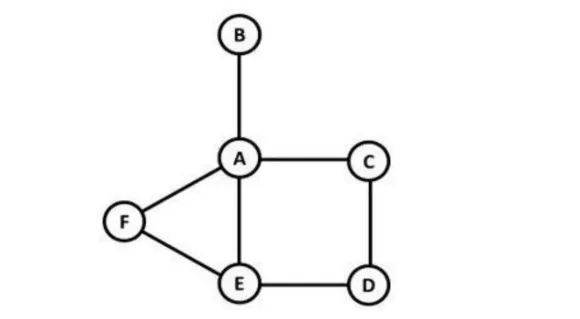
The teams need 30 minutes to cross a street connecting one police station to another. All four teams start from Station A at 09:00 hrs. and must return to Station A by 12:00 hrs. They can also pass via Station A at any point on their journeys.
The following facts are known.
Which one among the following stations is visited the largest number of times?
Correct Answer :
Station E
Solution :
To find which station is visited the largest number of times, we can trace the routes of the four teams step-by-step. The connections between the stations are shown in the diagram below:
Each team patrols continuously for 3 hours (from 09:00 to 12:00 hrs.), which is exactly 180 minutes. Since crossing any street takes 30 minutes, each team makes exactly 6 street crossings. Let us define the time intervals and checkpoints as:
T0 = 09:00 (Start at A)
T1 = 09:30
T2 = 10:00
T3 = 10:30
T4 = 11:00
T5 = 11:30
T6 = 12:00 (Return to A)
Step 1: Analyzing Team 4's Route
According to the rules:
- Team 4 never passes through stations B, D, or F (Fact 6).
- The only allowed stations for Team 4 are A, C, and E.
- Looking at the connections, C is only connected to A and D (since D is forbidden, Team 4 can only go A ↔ C).
- Similarly, E is connected to A, D, and F (since D and F are forbidden, Team 4 can only go A ↔ E).
- Therefore, Team 4 must alternate between A and {C, E}. This means Team 4 must be at A at times T0, T2, T4, and T6, and at C or E at times T1, T3, and T5.
- Fact 4 states that Team 4 is at station E at 11:30 (T5).
- Fact 3 states that only Teams 1 and 3 are at station E at 10:30 (T3), which means Team 4 must be at C at T3.
- At T1, Team 4 must be at E because if it were at C, it would conflict with Team 3 moving from A to C (as explained below).
Thus, the path of Team 4 is: A → E → A → C → A → E → A.
Step 2: Analyzing Team 3's Route
- At T2 (10:00), Team 3 is at D (Fact 2). Since it starts at A and cannot use the street A-E (Fact 5), the only path to reach D in 2 steps is A → C → D.
- At T3 (10:30), Team 3 is at E (Fact 3).
- To return to A by T6 (12:00) without using the street E-A (which is reserved only for Teams 1 and 4), Team 3 must go back via D and C.
Thus, the path of Team 3 is: A → C → D → E → D → C → A.
Step 3: Analyzing Team 1's Route
- At T3 (10:30), Team 1 is at E (Fact 3).
- At T5 (11:30), Team 1 is at B (Fact 4). Since the only neighbor of B is A, Team 1 must be at A at T4 (11:00) and T6 (12:00).
- At T3, Team 1 is at E and needs to reach A at T4. Since only Teams 1 and 4 can use the street A-E, Team 1 goes E → A.
- Prior to T3, Team 1 starts at A at T0, visits B at T1, and returns to A at T2.
Thus, the path of Team 1 is: A → B → A → E → A → B → A.
Step 4: Analyzing Team 2's Route
- At T2 (10:00), Team 2 is at E (Fact 2). Since it cannot use the street A-E, it must take the path A → F → E.
- From E at T2, it must leave because Teams 1 and 3 are the only ones at E at T3. It can travel to F, resulting in the path F → E at T1-T2 and E → F at T2-T3.
- The remaining steps of Team 2 will visit F and/or C, eventually returning to A at T6.
Step 5: Counting the Visits to Stations (excluding Station A)
Let us sum the number of visits to each station from the paths of Teams 1, 3, and 4:
- Station B: Visited 2 times (by Team 1 at T1 and T5).
- Station C: Visited 3 times (by Team 3 at T1 and T5, and by Team 4 at T3).
- Station D: Visited 2 times (by Team 3 at T2 and T4).
- Station E: Visited 4 times (by Team 1 at T3, Team 3 at T3, and Team 4 at T1 and T5).
Adding the visits of Team 2 (which starts at A, visits F at T1, E at T2, F at T3, and then returns to A):
- Station E gets at least 1 additional visit from Team 2 (at T2), bringing its total to at least 5 visits.
- Station C gets at most 1 visit from Team 2, bringing its total to at most 4 visits.
- Station F gets at most 3 visits from Team 2, bringing its total to at most 3 visits.
- Station D is not visited by Team 2.
Comparing the totals, Station E is visited the largest number of times (at least 5 times).
Access expert-curated educational resources and study materials—completely free.
Create, conduct, and manage professional online assessments with Mindyard. Perfect for teachers and institutes.
Copyright © 2026 Mindyard. All Rights Reserved.




