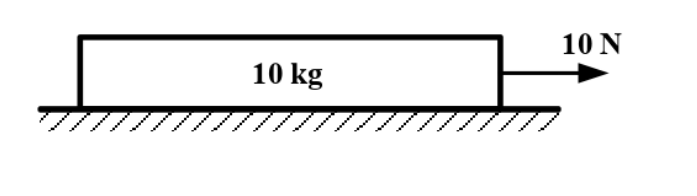
A block of mass 10 kg rests on a horizontal floor. The acceleration due to gravity is 9.81 m/s2. The coefficient of static friction between the floor and the block is 0.2. A horizontal force of 10 N is applied on the block as shown in the figure. The magnitude of force of friction (in N) on the block is _______.
Correct Answer :
Solution :
The correct answer is 10.
Step-by-step Explanation:
1. Identify the given parameters from the problem and the diagram:
- Mass of the block,
- Acceleration due to gravity,
- Coefficient of static friction,
- Applied horizontal force, (as shown pointing to the right in the diagram)
2. Calculate the normal reaction force:
The block is resting on a horizontal floor, so the normal force is equal to the weight of the block :
Substituting the given values:
3. Determine the maximum static friction force (limiting friction):
The maximum friction force that can act before the block starts to move is given by:
Substituting the values:
4. Analyze the state of motion and calculate the actual friction force:
- The applied horizontal force is .
- The maximum available static friction force is .
Since the applied force is less than the maximum static friction force (), the block does not move and remains in static equilibrium.
Under static equilibrium, the actual force of static friction () exactly balances the applied force:
Thus, the magnitude of the force of friction on the block is 10 N.
Access expert-curated educational resources and study materials—completely free.
Create, conduct, and manage professional online assessments with Mindyard. Perfect for teachers and institutes.
Copyright © 2026 Mindyard. All Rights Reserved.