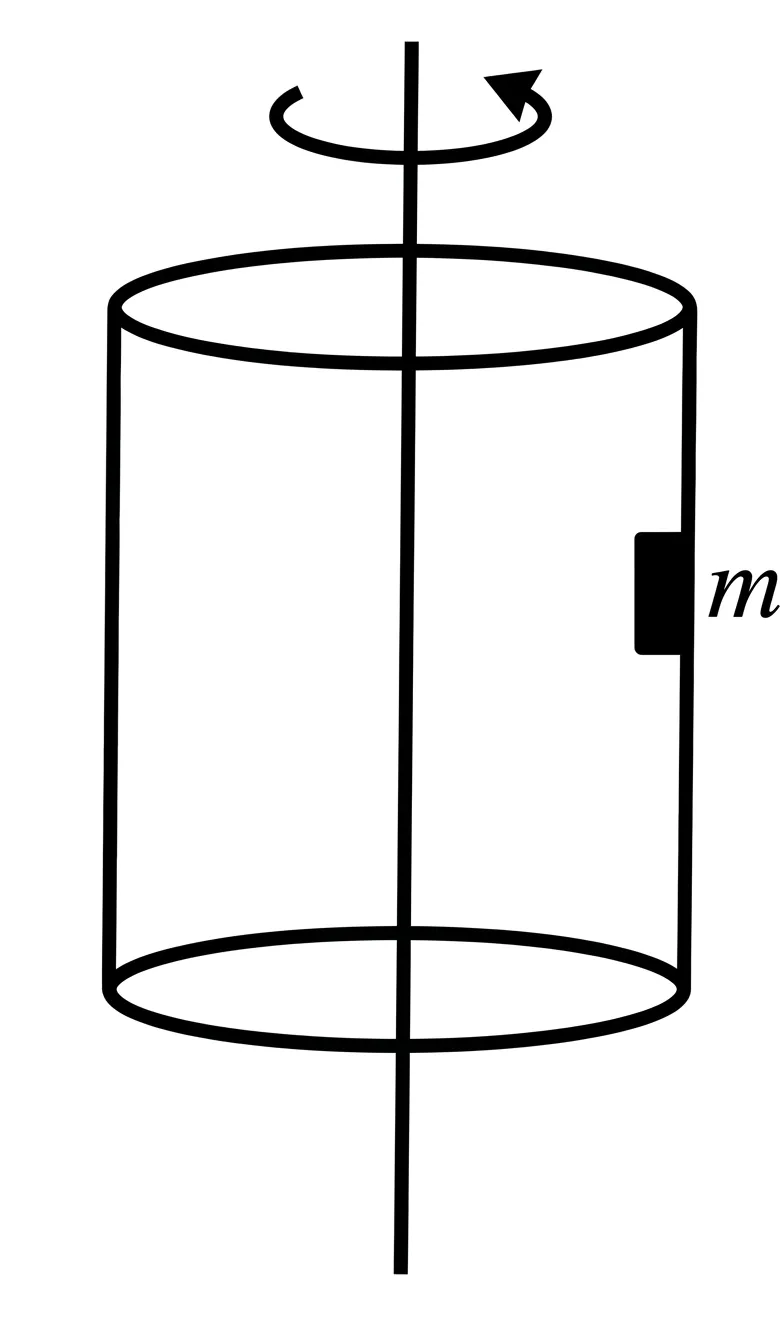
A block of mass m is at rest w.r.t. hollow cylinder which is rotating with angular speed . Radius of cylinder is R. Find minimum coefficient of friction between block and cylinder.
Correct Answer :
g/ω2R
Solution :
Correct Option: g/ω2R
Step-by-Step Explanation:
As seen in the provided diagram, a block of mass is pressed against the inner vertical wall of a hollow cylinder rotating with angular speed about its central axis. The radius of the cylinder is .
1. Analyzing the Forces acting on the block:
• Vertical direction: The downward gravitational force acting on the block is . To prevent the block from sliding down, an upward static frictional force acts between the inner wall of the cylinder and the block.
• Horizontal/Radial direction: The normal force exerted horizontally inward by the wall of the cylinder provides the necessary centripetal acceleration for circular motion of radius .
2. Setting up the Equations of Motion:
For horizontal circular motion with angular speed :
For vertical equilibrium (so the block does not slip down):
3. Condition for Static Friction:
The maximum available static friction force (limiting friction) is given by:
For the block to remain at rest relative to the cylinder, the required static friction force must not exceed the maximum static friction force:
Substituting into the inequality:
Canceling mass from both sides:
Solving for the coefficient of friction :
Thus, the minimum coefficient of friction required between the block and cylinder is:
Access expert-curated educational resources and study materials—completely free.
Create, conduct, and manage professional online assessments with Mindyard. Perfect for teachers and institutes.
Copyright © 2026 Mindyard. All Rights Reserved.