A block of negligible mass rests on a surface that is inclined at 30° to the horizontal plane as shown in the figure. When a vertical force of 900 N and a horizontal force of 750 N are applied, the block is just about to slide.
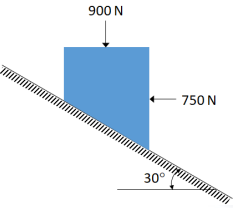
The coefficient of static friction between the block and surface is _______ (round off to two decimal places).
Correct Answer :
Correct answer is : 0.173
Solution :
The correct answer is 0.173.
Analysis of the Given Data and Diagram:
From the given images, we observe a block of negligible mass resting on an inclined plane. The inclination angle of the plane with the horizontal is 30°. Two external forces are acting on the block:
1. A vertical force of 900 N acting downwards.
2. A horizontal force of 750 N acting to the left (pushing the block up the incline).
Since the block is just about to slide, it is in a state of limiting equilibrium. Let us determine the coefficient of static friction () using two different methods: resolving forces parallel and perpendicular to the incline, and using Lami's theorem with the angle of friction.
Method 1: Resolving Forces along and perpendicular to the Incline
Let us define the coordinate axes such that the x-axis is parallel to the inclined plane (positive pointing up the incline) and the y-axis is perpendicular to the inclined plane (positive pointing outwards/up-right).
1. Resolving the 900 N vertical force:
- The component acting down the incline (along the negative x-direction):
- The component acting into the incline (along the negative y-direction):
2. Resolving the 750 N horizontal force:
Since the horizontal force points to the left, it makes an angle of 30° with the inclined plane direction. Therefore:
- The component acting up the incline (along the positive x-direction):
- The component acting into the incline (along the negative y-direction):
3. Normal Force (N):
Balancing the forces perpendicular to the inclined plane (along the y-axis):
4. Friction Force (f):
Comparing the force components along the incline, the force pushing the block up the incline (649.52 N) is greater than the component of weight pushing it down (450 N). Thus, the block has impending motion up the incline, meaning the static friction force acts down the incline:
Balancing the forces parallel to the inclined plane (along the x-axis):
Now, solving for :
Rounding to two decimal places (or three as specified in the options), we get:
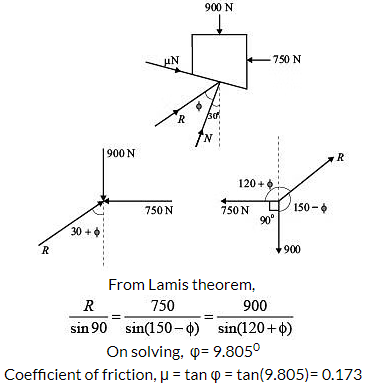
Method 2: Using Lami's Theorem and the Angle of Friction
Let be the angle of static friction, such that .
The resultant reaction force combines the normal force and the friction force , making an angle with the normal to the incline. Since the impending sliding motion is up the incline, the resultant force is tilted towards the down-incline direction by .
The three concurrent forces keeping the block in equilibrium are:
- The vertical force of 900 N (downwards)
- The horizontal force of 750 N (to the left)
- The resultant reaction force (pointing up and to the right)
Using the geometry of the system as shown in the second image, the angles between these three forces are:
- Angle between 900 N and 750 N = 90°
- Angle between 750 N and =
- Angle between 900 N and =
Applying Lami's Theorem:
Taking the ratio of the horizontal and vertical forces:
Expanding the sine terms:
Rearranging the terms to solve for :
Thus, the coefficient of static friction is:
Access expert-curated educational resources and study materials—completely free.
Create, conduct, and manage professional online assessments with Mindyard. Perfect for teachers and institutes.
Copyright © 2026 Mindyard. All Rights Reserved.