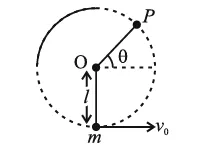
A bob of heavy mass m is suspended by a light string of length l. The bob is given a horizontal velocity v0 as shown in figure. If the string gets slack at some point P making an angle 𝜃 from the horizontal, the ratio of the speed v of the bob at point P to its initial speed v0 is:
Correct Answer :
Solution :
The correct option is:
Step-by-Step Explanation:
1. Analyzing the Position and Height at Point P:
In the given figure, a bob of mass m is suspended by a light string of length l. It is projected horizontally with an initial speed v0 from the bottommost position.
Let the bottommost point be the reference level for potential energy (height = 0).
At point P, the string makes an angle θ with the horizontal. The vertical height of point P above the center of the circular path O is given by l sin θ.
Therefore, the total height h of point P from the bottommost initial position is:
2. Applying Conservation of Mechanical Energy:
As there is no friction or non-conservative force acting on the bob, the mechanical energy is conserved between the bottommost point and point P:
Substituting and dividing by :
— (Equation 1)
3. Equation of Motion at Point P (Centripetal Force):
At point P, the forces acting along the radial direction (towards the center O) are the tension T in the string and the radial component of gravity:
At the point P where the string becomes slack, the tension becomes zero ():
Simplifying for v2:
— (Equation 2)
4. Finding the Ratio of Speeds:
Substitute the expression for v2 from Equation 2 into Equation 1:
Now, find the ratio of v2 to v02:
Taking the square root on both sides to find the ratio of the speeds:
Access expert-curated educational resources and study materials—completely free.
Create, conduct, and manage professional online assessments with Mindyard. Perfect for teachers and institutes.
Copyright © 2026 Mindyard. All Rights Reserved.