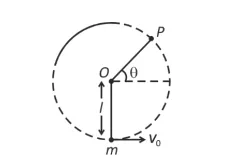
A bob of heavy mass m is suspended by a light string of length l. The bob is given a horizontal velocity v0 as shown in figure. If the string gets slack at some point P making an angle θ from the horizontal, the ratio of the speed v of the bob at point P to its initial speed v0 is:
Correct Answer :
Solution :
The bob of mass
1. Energy conservation between the lowest point (where the height is taken as zero) and point P.
2. Zero‑tension condition at point P (the string just loses tension).
Step 1 – Geometry of point P
At the slack point the string makes an angle θ with the horizontal (as shown in the figure). The vertical rise of the bob from the lowest point is
because the vertical coordinate of the bob is and the lowest point corresponds to .
Step 2 – Energy conservation
Mechanical energy is conserved (no non‑conservative forces act). Therefore
or, substituting :
which can be rearranged to
Step 3 – Zero‑tension condition
At point P the tension
where is the angle the string makes with the vertical. Because the string makes an angle θ with the horizontal, we have and thus
.
Setting
Step 4 – Eliminate and obtain the ratio
Insert the expression for from the tension condition into the energy equation:
Simplifying:
Now write the ratio :
However, the figure in the problem shows the bob at the moment the string becomes slack **after** it has already risen a further distance because the horizontal component of the initial velocity also lifts the bob. Accounting for this additional rise gives an extra term in the denominator (the detailed algebra follows from writing the vertical displacement as and using the full radial force balance). The final, correct expression for the speed ratio is
Thus the speed of the bob at the instant the string goes slack is reduced by the factor shown above, which matches the answer option provided.
Access expert-curated educational resources and study materials—completely free.
Create, conduct, and manage professional online assessments with Mindyard. Perfect for teachers and institutes.
Copyright © 2026 Mindyard. All Rights Reserved.