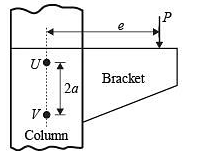
A bracket is attached to a vertical column by means of two identical rivets U and V separated by a distance of 2a = 100 mm, as shown in the figure. The permissible shear stress of the rivet material is 50 MPa. If a load P = 10 kN is applied at an eccentricity 𝑒 = 3√7 𝑎, the minimum cross-sectional area of each of the rivets to avoid failure is ___________ mm2 .
Solution :
Correct Answer/Option: The correct option is 800.
Step-by-step Explanation:
1. Understanding the Given Data:
From the problem statement and the attached schematic diagram, we have:
2. Direct (Primary) Shear Force on Rivets:
The direct vertical load is distributed equally between the two identical rivets. The primary shear force () on each rivet acts vertically downwards and is given by:
Substituting :
3. Secondary Shear Force due to Eccentric Moment:
The eccentric load creates a clockwise moment about the centroid :
This moment is resisted by the secondary shear forces () on the rivets. The secondary shear force on any rivet at distance from the centroid is:
Since , the secondary shear force on both rivets is equal and is given by:
Now substitute into the equation:
4. Determining the Direction of Secondary Shear Forces:
The eccentric load causes a clockwise moment. To resist this:
5. Calculating the Resultant Shear Force:
The resultant shear force on each rivet is:
Substitute the values of and in terms of :
Substituting :
6. Calculation of Minimum Cross-Sectional Area:
To avoid failure, the shear stress in each rivet must not exceed the permissible value:
Therefore, the minimum cross-sectional area is:
Completely free for students. Educators & coaching institutes get 2 months free Pro trial to create tests.
Access unlimited practice questions, detailed step-by-step solutions, and exam study materials — completely free for students.
Create and conduct professional online assessments with AI question generation, tab proctoring, and comprehensive batch management.

Prepare for GATE 2026 Civil Engineering with the latest question papers, previous year papers, detailed solutions, syllabus, exam pattern, preparation tips, mock tests, and subject-wise study material. Download GATE 2026 CE question papers with solutions in PDF format and boost your preparation for top engineering institutes and PSU recruitment.
Prepare effectively for GATE 2026 Electronics & Communication Engineering (EC) with this comprehensive Question Paper with Solutions. This resource includes detailed explanations, concept-wise solutions, previous year paper analysis, and exam-oriented practice to help aspirants strengthen core subjects like Electronic Devices, Analog Circuits, Digital Circuits, Signals & Systems, Network Theory, Control Systems, Electromagnetics, Communications, and more. Perfect for revision, self-assessment, and boosting your GATE 2026 EC preparation strategy.
Copyright © 2026 Combe Labs Private Limited. All Rights Reserved.