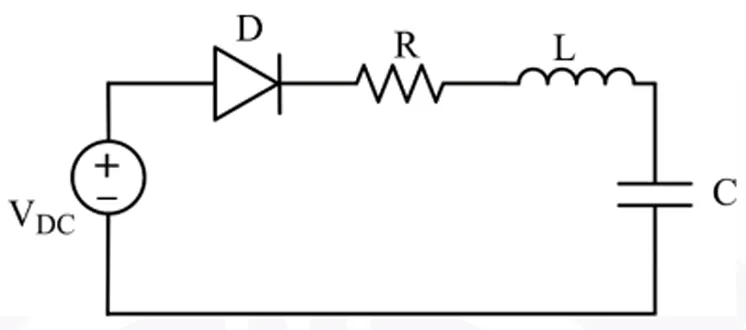
A circuit with ideal elements is shown. Which one of the following options correctly identifies all the linear elements in the circuit?
Correct Answer :
R, L, and C only
Solution :
The correct option is R, L, and C only.
Step-by-Step Explanation:
To determine which elements in the circuit are linear, we analyze their individual voltage-current (V-I) relationships and check if they satisfy the principle of superposition (which consists of the properties of additivity and homogeneity/scaling).
1. Resistor (R):
The voltage across an ideal resistor is directly proportional to the current flowing through it, according to Ohm's Law:
Since the relationship between voltage and current is a linear algebraic equation, the resistor R is a linear element.
2. Inductor (L):
The voltage across an ideal inductor is proportional to the time rate of change of the current:
Since differentiation is a linear operation, the relationship satisfies superposition, making the inductor L a linear element.
3. Capacitor (C):
The current through an ideal capacitor is proportional to the time rate of change of the voltage across it:
Similar to the inductor, the derivative relationship is linear, so the capacitor C is a linear element.
4. Diode (D):
A diode (labeled as D in the circuit diagram) is a semiconductor device that allows current to flow primarily in one direction. Its V-I characteristic is highly non-linear (e.g., behaving as an open circuit when reverse-biased and a short circuit or having an exponential voltage-current relationship when forward-biased). Because its V-I characteristics do not form a straight line passing through the origin and do not satisfy superposition, the diode D is a non-linear element.
5. DC Voltage Source (VDC):
An independent source like VDC maintains a constant voltage regardless of the current passing through it. Active independent sources do not satisfy the scaling/homogeneity property of linearity (scaling the current does not scale the voltage accordingly), and thus they are categorized as non-linear (or active, non-linear system components).
Conclusion:
Therefore, the only linear elements present in the circuit are the resistor R, the inductor L, and the capacitor C.
Access expert-curated educational resources and study materials—completely free.
Create, conduct, and manage professional online assessments with Mindyard. Perfect for teachers and institutes.
Copyright © 2026 Mindyard. All Rights Reserved.