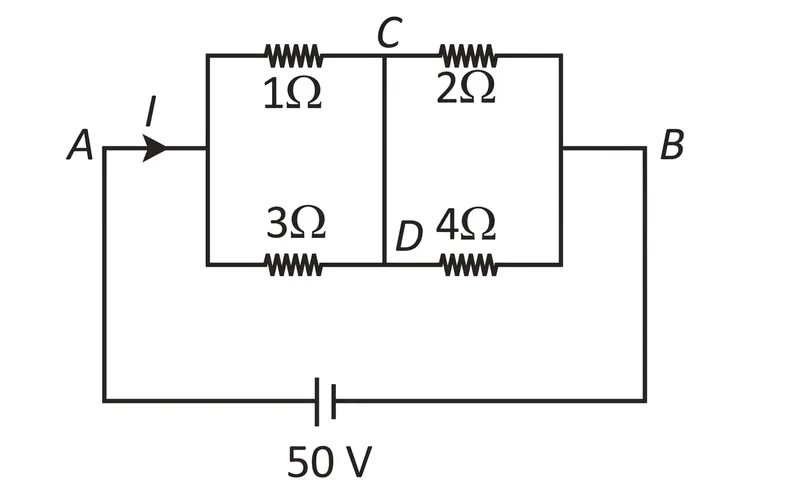
A constant voltage of 50 V is maintained between the points A and B of the circuit shown in the figure. The current through the branch CD of the circuit is:
Correct Answer :
2.0 A
Solution :
To find the current through the branch CD of the circuit, we can use the nodal analysis method.
Let us analyze the circuit shown in the diagram:
- A constant voltage of 50 V is maintained between terminals A and B. Let the electric potential at terminal B be , which means the electric potential at terminal A is .
- The branch CD is a connecting wire with zero resistance. This means the nodes C and D are at the same electric potential. Let this common potential be .
Now, let's write the expression for the currents entering and leaving the combined junction (supernode) C-D:
1. Current flowing from A to C through the 1 Ω resistor:
2. Current flowing from A to D through the 3 Ω resistor:
3. Current flowing from C to B through the 2 Ω resistor:
4. Current flowing from D to B through the 4 Ω resistor:
Applying Kirchhoff's Current Law (KCL) to the combined C-D supernode (Total current entering = Total current leaving):
Substituting the expressions into the KCL equation:
Multiply the entire equation by 12 (the least common multiple of 2, 3, and 4) to eliminate the denominators:
Combine like terms:
Thus, the potential at node C and node D is .
Next, we calculate the individual currents at node C:
- Current entering node C from terminal A:
- Current leaving node C to terminal B:
By applying Kirchhoff's Current Law at node C, the net current must balance. Since 18 A enters from A and only 16 A leaves towards B, the remaining current must flow downwards from node C to node D through the branch CD:
Alternatively, verifying at node D:
- Current entering node D from terminal A:
- Current leaving node D to terminal B:
Since 8 A leaves towards B but only 6 A enters from A, the additional 2.0 A must enter node D from branch CD, confirming a downward current of 2.0 A.
Therefore, the current through the branch CD is 2.0 A.
Access expert-curated educational resources and study materials—completely free.
Create, conduct, and manage professional online assessments with Mindyard. Perfect for teachers and institutes.
Copyright © 2026 Mindyard. All Rights Reserved.