
A container of height 2 m, length 2 m and breadth 1 m is made of insulating vertical walls and two large area horizontal metal plates (M1 and M2) which extend far beyond the vertical walls in all directions. The container is partitioned into two equal chambers with a thin insulating vertical wall. The partition wall contains a small hole of cross-sectional area near its bottom edge. Initially the hole is closed and the left chamber of the container is completely filled with a liquid of dielectric constant εr = 15 and the right chamber is empty (εr = 1). At time t = 0, the hole is opened and the liquid flows from the left chamber to the right chamber. In both the chambers, the space above the liquid has εr = 1 and is maintained at atmospheric pressure. The schematic of the container at a time t > 0 is shown in the figure.
[Given: acceleration due to gravity is 10 m s-2.]
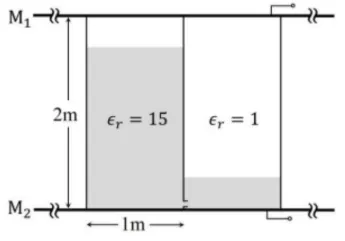
The height (in m) of the liquid in left chamber at t = 500 s is:
Solution :
The correct answer is 1.25.
Step-by-step Explanation:
1. Understanding the System Setup & Parameters:
From the given description and diagram, we have:
- Total height of the container: H = 2 m
- Length of the container: L = 2 m (partitioned into two equal chambers, so each chamber has length l = 1 m)
- Breadth of the container (into the page): b = 1 m
- Cross-sectional area of each chamber's base: Ac = l × b = 1 m × 1 m = 1 m2
- Hole area: a =
- Acceleration due to gravity: g = 10 m s-2
- Dielectric constant of the liquid: εr = 15
- Dielectric constant of the region above the liquid: εr = 1
2. Conservation of Volume:
Initially, the left chamber is completely filled with liquid to a height of 2 m, and the right chamber is empty.
Let h1 be the height of the liquid in the left chamber at time t, and h2 be the height of the liquid in the right chamber at time t.
Since the total liquid volume is conserved:
3. Applying Torricelli's Law / Speed of Efflux:
The difference in liquid levels between the left and right chambers is:
By Torricelli's theorem, the velocity of flow through the small hole near the bottom is:
4. Setting up the Differential Equation:
The rate of decrease of liquid volume in the left chamber is equal to the volume flow rate through the hole:
5. Integrating to Find h1 at t = 500 s:
Separating variables and integrating from t = 0 (where h1 = 2 m) to t = 500 s:
Substitute g = 10 m s-2 and a = :
Now substitute this back into the equation:
Squaring both sides:
Thus, the height of the liquid in the left chamber at t = 500 s is 1.25 m.
Completely free for students. Educators & coaching institutes get 2 months free Pro trial to create tests.
Access unlimited practice questions, detailed step-by-step solutions, and exam study materials — completely free for students.
Create and conduct professional online assessments with AI question generation, tab proctoring, and comprehensive batch management.

A comprehensive JEE Advanced 2022 Paper 1 designed to help aspirants understand the examination pattern, difficulty level, and question trends of JEE Advanced. This paper covers important concepts from Physics, Chemistry, and Mathematics, featuring a balanced mix of conceptual, numerical, and advanced application-based questions. It helps students strengthen conceptual understanding, enhance analytical and problem-solving skills, and improve speed and accuracy. Ideal for practice, revision, self-assessment, previous year trend analysis, concept reinforcement, and time management, this paper is a valuable resource for effective JEE Advanced preparation.

A comprehensive JEE Advanced 2022 Paper 2 designed to help aspirants understand the examination pattern, difficulty level, and question trends of JEE Advanced. This paper covers important concepts from Physics, Chemistry, and Mathematics, featuring a balanced mix of conceptual, numerical, and advanced application-based questions. It helps students strengthen conceptual understanding, enhance analytical and problem-solving skills, and improve speed and accuracy. Ideal for practice, revision, self-assessment, previous year trend analysis, concept reinforcement, and time management, this paper is a valuable resource for effective JEE Advanced preparation.
Copyright © 2026 Combe Labs Private Limited. All Rights Reserved.


