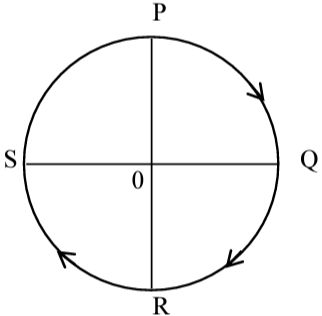
A cyclist starts from the point P of a circular ground of radius 2 km and travels along its circumference to the point S. The displacement of a cyclist is :
Correct Answer :
√8 km
Solution :
The correct answer is √8 km.
From the image, we can clearly see a circle with center O and four points marked on its circumference:
• P — at the top (12 o'clock position)
• Q — at the right (3 o'clock position)
• R — at the bottom (6 o'clock position)
• S — at the left (9 o'clock position)
The arrows in the diagram show the cyclist travels along the circumference in the direction P → Q → R → S (i.e., three-quarters of the circle in the clockwise direction).
Key Concept — Displacement vs. Distance:
• Distance is the total path length traveled along the circumference.
• Displacement is the straight-line (shortest) distance between the starting point and the ending point, regardless of the path taken.
So we need the straight-line distance from P to S.
Step 1: Set up coordinates.
Place the center O at the origin. The radius of the circle is r = 2 km.
• P is at the top: coordinates = (0, 2)
• S is at the left: coordinates = (-2, 0)
Step 2: Apply the Distance Formula.
The displacement = straight-line distance PS =
Substituting the coordinates of P(0, 2) and S(-2, 0):
Alternative Method (using Pythagoras):
Since P is directly above O and S is directly to the left of O, the triangle OPS has:
• OP = 2 km (radius, vertical)
• OS = 2 km (radius, horizontal)
• Angle POS = 90°
By the Pythagorean theorem:
Therefore, the displacement of the cyclist from P to S is √8 km.
Access expert-curated educational resources and study materials—completely free.
Create, conduct, and manage professional online assessments with Mindyard. Perfect for teachers and institutes.
Copyright © 2026 Mindyard. All Rights Reserved.