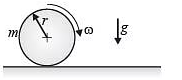
A cylindrical disc of mass 𝑚 = 1 kg and radius 𝑟 = 0.15 m was spinning at 𝜔 = 5 rad/s when it was placed on a flat horizontal surface and released (refer to the figure). Gravity g acts vertically downwards as shown in the figure. The coefficient of friction between the disc and the surface is finite and positive. Disregarding any other dissipation except that due to friction between the disc and the surface, the horizontal velocity of the center of the disc, when it starts rolling without slipping, will be _________ m/s (round off to 2 decimal places).
Correct Answer :
Correct answer is : 0.25
Law of conservation of angular momentum: the angular momentum of a system remains conserved as long as there is no net external torque acting on the system.
angular momentum, = m × V × r
where, m = mass, V = velocity, r = radius
p = linear momentum = m × V
I = moment of inertia = mr2
ω = angular velocity =
A is the center of mass(CM), B is the point of contact
Given:
mass m = 1 kg, r = 0.15 m, 𝜔 = 5 rad/s
Moment of inertia for the disc I = mr2/2 = 0.01125 mm
By the law of conservation of angular momentum:
Initial angular momentum = Final angular momentum
Solution :
The correct answer is 0.25.
1. Analysis of the Image and Given Parameters:
The provided diagram shows a cylindrical disc of mass m and radius r spinning clockwise with an initial angular velocity ω = 5 rad/s. A vertical arrow labeled g points downwards, indicating gravity. The disc is placed on a flat horizontal surface where the coefficient of friction is finite and positive. The physical properties given are:
Mass of the disc, m = 1 kg
Radius of the disc, r = 0.15 m
Initial angular velocity, ω0 = 5 rad/s
Initial linear velocity of the center of mass, V0 = 0 m/s
2. Principles of Physics:
When the spinning disc is placed on the horizontal surface, the bottom-most point of the disc slides to the left relative to the ground. This relative motion generates a friction force acting to the right (forward direction) at the point of contact. Because this friction force is the only horizontal force acting on the disc, it exerts a torque that slows down the rotation while simultaneously accelerating the disc linearly forward.
Since the line of action of the friction force passes through the contact point on the ground, the net external torque about the point of contact (or any fixed point on the line of travel on the ground) is zero. Therefore, we can apply the Law of Conservation of Angular Momentum about the point of contact on the ground.
3. Formulation of Angular Momentum:
The initial angular momentum about the point of contact on the ground is due solely to the spin of the disc, since the center of mass is initially stationary (V0 = 0):
For a solid cylindrical disc, the moment of inertia about its central axis is:
Thus, the initial angular momentum is:
When the disc begins to roll without slipping, it attains a final linear velocity V and a final angular velocity ωf. The condition for rolling without slipping is:
The final angular momentum about the point of contact on the ground is the sum of the angular momentum about its center of mass and the angular momentum due to the linear translation of its center of mass:
Substituting the expression for the moment of inertia and the no-slip condition into the final angular momentum equation:
4. Equating Initial and Final Angular Momentum:
Applying the conservation law (Li = Lf):
Solving for the final linear velocity V:
5. Step-by-Step Calculation:
Substitute the given values into the derived equation:
Therefore, the horizontal velocity of the center of the disc when it starts rolling without slipping is 0.25 m/s.
Access expert-curated educational resources and study materials—completely free.
Create, conduct, and manage professional online assessments with Mindyard. Perfect for teachers and institutes.
Copyright © 2026 Mindyard. All Rights Reserved.