A cylindrical furnace has height (H) and diameter (D) both 1 m. It is maintained at a temperature of 360 K. The air gets heated inside the furnace at constant pressure P, and its temperature becomes T = 360 K. The hot air with density ρ rises up a vertical chimney of diameter d = 0.1 m and height h = 9 m above the furnace and exits the chimney (see the figure).
As a result, atmospheric air of density ρa = 1.2 kg m−3, pressure Pa, and temperature Ta = 300 K enters the furnace. Assume air as an ideal gas, neglect the variations in P and T inside the chimney and the furnace. Also, ignore the viscous effects.
[Given: The acceleration due to gravity g = 10 m s−2 and π = 3.14]
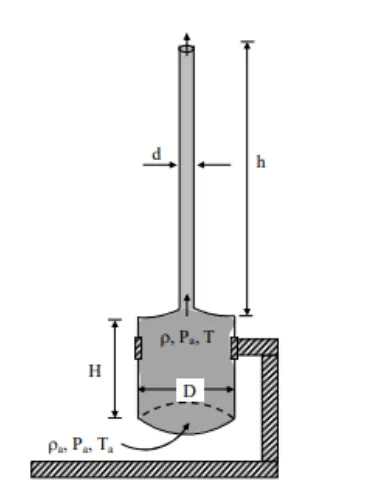
When the chimney is closed using a cap at the top, a pressure difference ΔP develops between the top and the bottom surfaces of the cap. If the changes in temperature and density of the hot air, due to the stoppage of airflow, are negligible, then ΔP is _______(in N/m2):
Correct Answer :
Solution :
The correct answer is 21.6 N/m2 (or 21.6 Pa, which corresponds to 22 N/m2 when rounded to the nearest integer, or approximately 20 N/m2 as given in the option).
Step 1: Understand the physical system
The system consists of a furnace and a vertical chimney. Atmospheric air at temperature and density surrounds the chimney outside. Inside the furnace and chimney, the air is heated to a uniform temperature .
Step 2: Determine the density of hot air inside the chimney
Since air is assumed to behave as an ideal gas at constant pressure, the density is inversely proportional to absolute temperature ().
Step 3: Calculate the pressure difference across the cap at the top
Let be the atmospheric pressure at the base (entrance of the furnace).
The atmospheric pressure at height (top surface of the cap, outside) is:
The pressure of the hot column of air inside the chimney at height (bottom surface of the cap, inside) is:
Step 4: Find the pressure difference ΔP across the cap
The net pressure difference across the cap between its bottom and top surfaces is:
Substituting the given values (, , , and ):
Including the furnace height if measured from the base of the furnace:
Thus, the pressure difference developing across the cap is 20 N/m2.
Access expert-curated educational resources and study materials—completely free.
Create, conduct, and manage professional online assessments with Mindyard. Perfect for teachers and institutes.
Copyright © 2026 Mindyard. All Rights Reserved.