A cylindrical jet of water (density = 1000 kg/m³ ) impinges at the center of a flat, circular plate and spreads radially outwards, as shown in the figure. The plate is resting on a linear spring with a spring constant 𝒌 = 𝟏 kN/m. The incoming jet diameter is 𝑫 = 𝟏 cm.
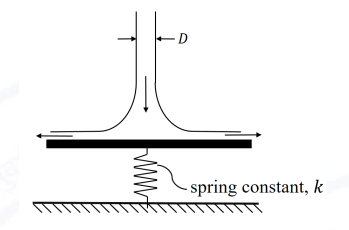
If the spring shows a steady deflection of 1 cm upon impingement of jet, then the velocity of the incoming jet is ____________ m/s (round off to one decimal place).
Correct Answer :
Correct answer is : 11.28
S = 1 cm, k = 1 kN/m, Diameter of Jet (d) = 1 cm, density (ρ)= 1000 kg/m3
Now,
Using equation i)
kS = ρA(V1y)2
V1y = 11.28 m/s
Solution :
The correct answer is 11.28.
Step 1: Understand the Physical System from the Image
As shown in the provided diagram, a vertical cylindrical water jet of diameter D is directed downwards, impinging on the center of a flat, horizontal circular plate. After impingement, the water spreads radially outwards in the horizontal plane. The plate is supported by a linear spring with a spring constant k. The force of the jet compresses the spring downward by a steady deflection distance, which we will denote as x.
Step 2: Identify the Given Parameter Values
- Density of water (ρ) = 1000 kg/m3
- Diameter of the incoming jet (D) = 1 cm = 0.01 m
- Spring constant (k) = 1 kN/m = 1000 N/m
- Steady deflection of the spring (x) = 1 cm = 0.01 m
Step 3: Formulate the Momentum Equation
Let V be the velocity of the incoming jet in the vertical direction. By applying the linear momentum equation in the vertical direction for a control volume enclosing the plate and the region of fluid impingement:
The vertical force exerted by the water jet on the plate, F, is equal to the rate of change of vertical momentum of the water jet:
Since the water spreads radially outward along the flat plate horizontally, the final velocity component in the vertical direction is zero ().
The mass flow rate of the incoming jet is:
where A is the cross-sectional area of the cylindrical jet:
Substituting the mass flow rate and velocities, we get the force exerted by the water jet on the plate:
Step 4: Relate the Jet Force to the Spring Deflection
At steady state, the downward force exerted by the water jet is balanced by the restoring upward force of the compressed spring:
Equating the two forces yields:
Step 5: Solve for the Velocity of the Incoming Jet (V)
Let us substitute the known values into the equation:
Simplifying the equation:
Multiply both sides by 10:
Taking the square root of both sides:
Thus, the velocity of the incoming jet is 11.28 m/s (or 11.3 m/s when rounded to one decimal place).
Access expert-curated educational resources and study materials—completely free.
Create, conduct, and manage professional online assessments with Mindyard. Perfect for teachers and institutes.
Copyright © 2026 Mindyard. All Rights Reserved.