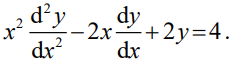
A differential equation is given as 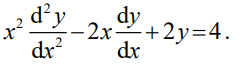 The solution of the differential equation in
terms of arbitrary constants C1 and C2 is bhjvhhgghvhbjj
The solution of the differential equation in
terms of arbitrary constants C1 and C2 is bhjvhhgghvhbjj
Options
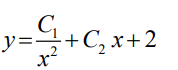
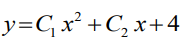

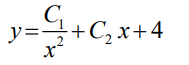
Correct Answer :
Solution :
The correct answer is:
Step-by-step Explanation:
1. Identify the type of differential equation:
From the first image, the given differential equation is:
This is a second-order Cauchy-Euler (homogeneous linear) differential equation.
2. Find the Complementary Function ():
For the homogeneous part, we assume a solution of the form .
Substituting , , and into the homogeneous equation yields:
Factoring out (since ), we obtain the auxiliary equation:
Factoring the quadratic equation:
Thus, the roots are and .
The complementary function is:
3. Find the Particular Integral ():
Since the right-hand side of the differential equation is a constant (), we assume a particular solution of the form:
where is a constant. Taking derivatives:
Substitute these values back into the original differential equation:
Therefore, the particular integral is:
4. Combine to get the Complete Solution:
The general solution is the sum of the complementary function and the particular integral:
Access expert-curated educational resources and study materials—completely free.
Create, conduct, and manage professional online assessments with Mindyard. Perfect for teachers and institutes.
Copyright © 2026 Mindyard. All Rights Reserved.