(a) Differentiate between malignant and benign tumours.
(b) Name and explain the most feared property of a malignant tumour.
Correct Answer :
(a)
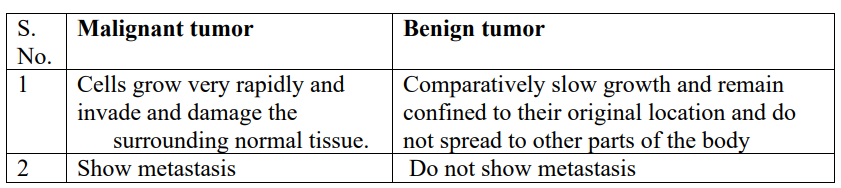
(b)
• Metastasis
• Cells from these tumors slough off and reach distant sites through blood, wherever they get lodged in the body they start a new tumor there.
Solution :
Correct Answer:
(a) The differences visible in the image table are:
• Malignant tumor: Cells grow very rapidly and invade and damage the surrounding normal tissue, and they show metastasis.
• Benign tumor: Comparatively slow growth and remain confined to their original location and do not spread to other parts of the body, and they do not show metastasis.
(b) The most feared property is Metastasis: Cells from these tumors slough off and reach distant sites through blood, and wherever they get lodged in the body, they start a new tumor there.
Step-by-Step Explanation:
Part (a): Differentiating Between Malignant and Benign Tumors
A tumor (or neoplasm) is an abnormal mass of tissue that forms when cells grow and divide more than they should or do not die when they should. Tumors are broadly classified into two categories based on their behavior, growth rate, and ability to spread:
1. Benign Tumors: As detailed in the provided image table under S. No. 1, these tumors grow relatively slowly. Their defining characteristic is that they remain localized to the area where they originated. They do not invade surrounding tissues or travel to distant parts of the body (no metastasis). Because they remain encapsulated and confined, they are generally less harmful and can often be safely removed via surgery.
2. Malignant Tumors: As detailed in the image table under S. No. 1, malignant tumors consist of cancerous cells that grow at a very rapid rate. Unlike benign tumors, they do not remain confined. Instead, they actively invade, penetrate, and destroy the surrounding healthy tissues, disrupting normal organ functions.
Part (b): The Most Feared Property of Malignant Tumors (Metastasis)
As indicated in S. No. 2 of the table, malignant tumors "Show metastasis," whereas benign tumors "Do not show metastasis."
• What is Metastasis? Metastasis is the spread of cancer cells from the primary (original) tumor site to distant organs and tissues throughout the body.
• How it occurs:
1. Sloughing Off: As a malignant tumor grows rapidly, the adhesion between cancer cells is lost (due to alterations in cell-adhesion molecules like cadherins). This allows individual cells or groups of cells to detach or slough off from the primary tumor.
2. Circulation: These detached cells invade nearby blood vessels or lymphatic vessels and enter the circulatory system.
3. Colonization: The blood carries these cancer cells to distant organs (such as the lungs, liver, brain, or bones). Wherever these cells get lodged in the microvasculature, they exit the bloodstream, invade the local tissue, and begin to proliferate, establishing secondary tumors (metastases).
• Why it is feared: Metastasis makes cancer extremely difficult to treat because the disease is no longer localized to a single area. Standard localized therapies, like surgery or radiation, are insufficient once metastasis has occurred, requiring systemic treatments like chemotherapy or immunotherapy.
Access expert-curated educational resources and study materials—completely free.
Create, conduct, and manage professional online assessments with Mindyard. Perfect for teachers and institutes.
Copyright © 2026 Mindyard. All Rights Reserved.
 Set - 3-1782888548748.webp)