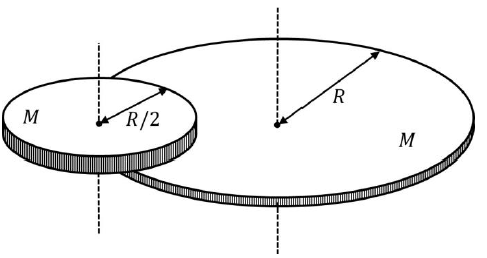
A disc of mass 𝑀 and radius 𝑅 is free to rotate about its vertical axis as shown in the figure. A battery operated motor of negligible mass is fixed to this disc at a point on its circumference. Another disc of the same mass 𝑀 and radius 𝑅/2 is fixed to the motor’s thin shaft. Initially, both the discs are at rest. The motor is switched on so that the smaller disc rotates at a uniform angular speed 𝜔. If the angular speed at which the large disc rotates is 𝜔/𝑛, then the value of 𝑛 is _____.
Correct Answer :
Solution :
The correct answer is 12.
Step-by-step derivation:
1. Identify the components of the system:
- A large disc of mass M and radius R, which rotates about its own center (let this axis be O).
- A motor of negligible mass fixed at the circumference of the large disc, i.e., at a distance R from the center O.
- A smaller disc of mass M and radius R/2, mounted on the motor's shaft. Its axis of rotation is vertical and passes through its center of mass, which is situated at a distance of R from the center O.
2. Moment of inertia calculations:
The moment of inertia of the large disc about its central vertical axis is:
The moment of inertia of the smaller disc about its own central axis is:
3. Conservation of angular momentum:
Since the system is initially at rest and no external torque acts on the system about the vertical axis passing through O, the total angular momentum L of the system about this axis must remain conserved and equal to zero.
4. Formulate the angular momentum terms:
Let the large disc rotate with an angular speed in one direction (say, counter-clockwise).
The angular momentum of the large disc about the axis O is:
For the smaller disc, its total angular momentum about the axis O consists of two parts:
- The orbital angular momentum due to the circular motion of its center of mass (which is at a distance R and rotates with the large disc at angular speed ):
- The spin angular momentum due to its rotation about its own center of mass with angular speed in the opposite direction:
5. Solve for n:
Set the sum of these angular momenta to zero:
Divide the entire equation by :
Comparing this with the given expression , we find:
Access expert-curated educational resources and study materials—completely free.
Create, conduct, and manage professional online assessments with Mindyard. Perfect for teachers and institutes.
Copyright © 2026 Mindyard. All Rights Reserved.