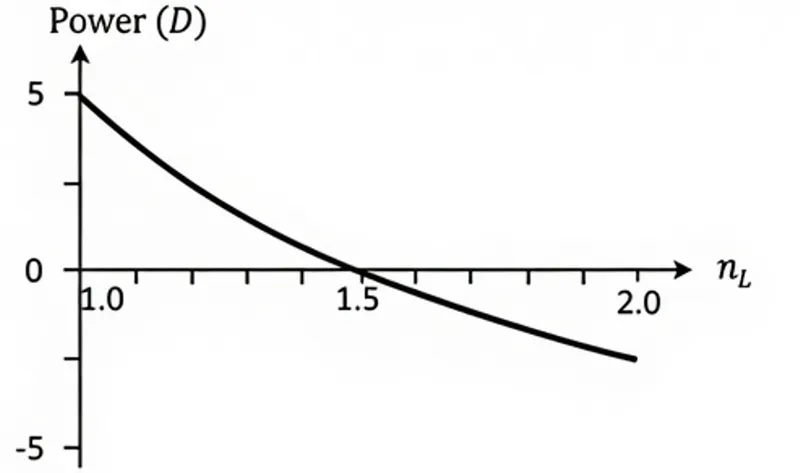
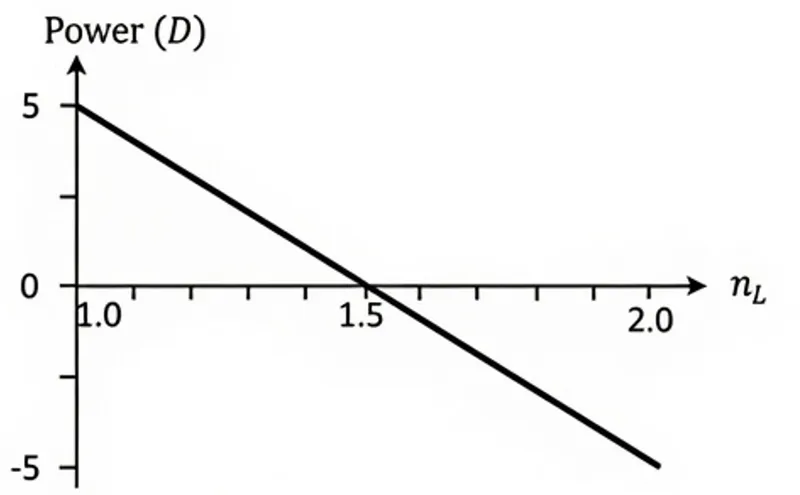
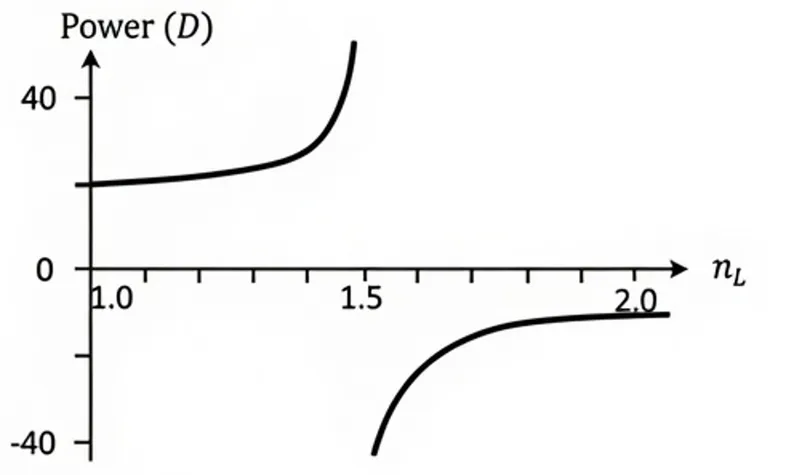
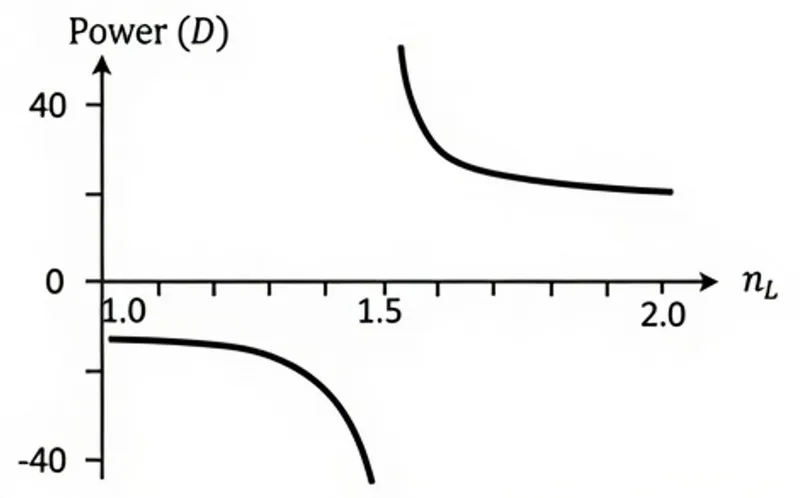
A double convex lens made of glass of refractive index 1.5 and radii of curvature 20 cm each is immersed in a liquid of refractive index nL. The correct plot showing the variation of the power, in the units of diopter (D), as a function of nL, is:
Options
Correct Answer :
Solution :
Correct Answer:
Explanation and Step-by-Step Derivation:
1. Understanding Lens Maker's Formula:
When a lens of refractive index ng is immersed in a liquid of refractive index nL, its power P is given by the Lens Maker's Formula:
2. Substituting the Given Values:
- Refractive index of glass lens, ng = 1.5
- For a double convex lens, using Cartesian sign conventions:
R1 = +20 cm = +0.2 m
R2 = -20 cm = -0.2 m
Therefore, the curvature factor is:
3. Power as a Function of nL:
Substituting these values back into the power equation:
4. Analyzing Key Features of the Graph P vs nL:
- When nL = 1 (in air):
P = 10(1.5 - 1) = +5 D. Thus, the graph must start at a positive power when nL = 1.
- When nL = ng = 1.5:
P = 10(1 - 1) = 0 D. The power becomes zero, so the graph crosses the nL-axis at nL = 1.5.
- When nL > 1.5:
The fraction 1.5 / nL < 1, which makes P negative (the double convex lens acts as a diverging lens in a denser medium). As nL increases further, P approaches -10 D asymptotically.
- Shape of the curve:
Since P is inversely proportional to nL (with a negative shift), the function represents a rectangular hyperbola curve with a negative slope that decreases continuously as nL increases.
Conclusion:
The plot that correctly displays a hyperbola starting at P > 0 for nL = 1, crossing zero at nL = 1.5, and becoming negative for nL > 1.5 is shown in the chosen option.
Access expert-curated educational resources and study materials—completely free.
Create, conduct, and manage professional online assessments with Mindyard. Perfect for teachers and institutes.
Copyright © 2026 Mindyard. All Rights Reserved.