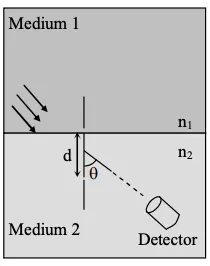
A double slit setup is shown in the figure. One of the slits is in medium 2 of refractive index n2. The other slit is at the interface of this medium with another medium 1 of refractive index n1 (. The line joining the slits is perpendicular to the interface and the distance between the slits is d. The slit widths are much smaller than d. A monochromatic parallel beam of light is incident on the slits from medium 1. A detector is placed in medium 2 at a large distance from the slits, and at an angle θ from the line joining them, so that θ equals the angle of refraction of the beam. Consider two approximately parallel rays from the slits received by the detector.
Which of the following statements (s) is (are) correct ?
Correct Answer :
The phase difference between the two rays is independent of d.
The two rays interfere constructively at the detector.
Solution :
The correct answers are: "The phase difference between the two rays is independent of d" and "The two rays interfere constructively at the detector."
Setting up the Geometry from the Figure:
From the diagram, Medium 1 (refractive index n₁) is on top and Medium 2 (refractive index n₂) is on the bottom. The interface is the horizontal boundary between them. Slit S₁ sits exactly at this interface, and Slit S₂ is at distance d directly below S₁, inside Medium 2. A monochromatic parallel beam (plane wave) in Medium 1 strikes the interface at angle of incidence α. By Snell's Law:
The detector in Medium 2 is placed at angle θ (the refraction angle) from the line joining the slits (the vertical axis).
Step 1: Coordinate System
Let us place S₁ at the origin (0, 0) on the interface, with the x-axis pointing downward (into Medium 2) — perpendicular to the interface — and the y-axis running along the interface. Then:
• S₁ is at (0, 0) — at the interface
• S₂ is at (d, 0) — inside Medium 2
The incident plane wave in Medium 1 travels at angle α to the x-axis (normal). A ray from this plane wave that reaches S₂ does NOT enter directly from above S₂; instead, it must first cross the interface at some point. Tracing the refracted ray in Medium 2 backward from S₂ (direction at angle θ to x-axis), it hits the interface at the point P = (0, −d tan θ).
Step 2: Phase Accumulated by Ray 2 at S₂ (Incident Part)
The incident plane wave in Medium 1 has phase:
Taking the phase at S₁ = (0,0) as the reference (φ₁ = 0), the phase at the interface entry point P = (0, −d tan θ) for Ray 2 is:
Substituting Snell's Law (n₁ sin α = n₂ sin θ):
After crossing the interface at P = (0, −d tan θ), the ray travels through Medium 2 to S₂ at (d, 0). The geometric distance is:
Phase accumulated in Medium 2 on this leg:
Total phase at S₂ relative to S₁ (from the incident wave):
Simplifying the bracket:
Therefore:
Step 3: Phase Difference for Paths from Slits to Detector
The detector is far away in Medium 2, in direction (cos θ, sin θ) from the x-axis. For a distant detector, the path length difference between the two rays from S₁ and S₂ is found by projecting the displacement S₂ − S₁ = (d, 0) onto the detector direction:
This means S₂ is closer to the detector by d cos θ, so Ray 2 travels less in Medium 2 by this amount. The phase contribution (Ray 2 minus Ray 1) for this leg:
Step 4: Net Phase Difference Between the Two Rays
Adding both contributions:
The two terms cancel exactly and completely.
Step 5: Evaluating Each Option
Option 1 — "The phase difference is independent of d" ✓ CORRECT:
The net phase difference is Δφ = 0 for all values of d. The two terms that contain d cancel identically. Therefore the phase difference is not just independent of d — it is identically zero for every value of d.
Option 2 — "The two rays interfere constructively at the detector" ✓ CORRECT:
Since Δφ = 0, the two rays are perfectly in phase. This is the condition for constructive interference. The physical reason is elegant: the extra path gained during the incidence leg (because Ray 2 enters medium 2 at a displaced point and travels an extra distance inside it before reaching S₂) is exactly equal in optical path length to the shorter path from S₂ to the detector compared to S₁. These two effects cancel precisely because the detector is placed at angle θ — the same angle of refraction — making the geometry self-consistent via Snell's Law.
Option 3 — "Phase difference depends on n₁ but is independent of n₂" ✗ INCORRECT:
The phase difference is zero — it depends on neither n₁ nor n₂. Snell's Law was used in the derivation to replace n₁ sin α with n₂ sin θ, but the final result of Δφ = 0 is independent of all material parameters.
Option 4 — "The phase difference vanishes only for certain values of d and angle of incidence" ✗ INCORRECT:
The phase difference is zero for all values of d and for any angle of incidence α (as long as θ is the corresponding refraction angle where the detector is placed). It is not restricted to special values.
Summary:
The beautiful physical insight here is that placing the detector exactly at the refraction angle θ creates a perfect geometric symmetry: the "extra" optical path accumulated when the incident wavefront reaches S₂ (via refraction into Medium 2) is exactly compensated by the shorter path from S₂ to the detector. The cancellation is exact, universal (independent of d, n₁, n₂, and the specific value of α), and results in permanent constructive interference at the detector.
Access expert-curated educational resources and study materials—completely free.
Create, conduct, and manage professional online assessments with Mindyard. Perfect for teachers and institutes.
Copyright © 2026 Mindyard. All Rights Reserved.