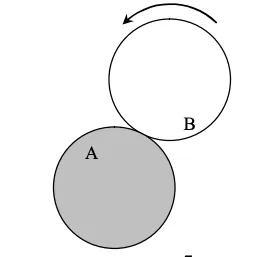
A flat surface of a thin uniform disk A of radius R is glued to a horizontal table. Another thin uniform disk B of mass M and with the same radius R rolls without slipping on the circumference of A, as shown in the figure. A flat surface of B also lies on the plane of the table. The center of mass of B has fixed angular speed ω about the vertical axis passing through the center of A. The angular momentum of B is with respect to the center of A. Which of the following is the value of n ?
Correct Answer :
5
Solution :
The correct answer is n = 5.
The figure shows disk A (radius R, fixed and glued to the table) and disk B (mass M, radius R) rolling without slipping on the outer circumference of A. The center of B orbits the center of A at angular speed ω. Since both disks have the same radius R, the center of B is always at a distance of 2R from the center of A.
The total angular momentum of B about the center of A consists of two parts:
Part 1: Orbital Angular Momentum (Lorbital)
This is the angular momentum due to the motion of the center of mass (CM) of B revolving around the center of A.
The speed of the center of B around the center of A is:
So the orbital angular momentum is:
Part 2: Spin Angular Momentum (Lspin)
Disk B rolls without slipping on the circumference of A. This means disk B also rotates (spins) about its own center.
The no-slip rolling condition: Since both disks have the same radius R, when the center of B completes one full revolution (angular speed ω) around A, disk B must spin on its own axis. The contact point velocity must be zero (no slip), so:
where is the spin angular speed of disk B about its own center. Solving:
More carefully:
The moment of inertia of a thin uniform disk about its own central axis is:
So the spin angular momentum about B's own center (directed vertically upward, same direction as the orbital angular momentum since B rolls in the same sense) is:
Total Angular Momentum:
By the parallel axis theorem approach (or equivalently, direct addition since both contributions are along the same vertical axis):
Comparing with the given expression , we get:
Summary of Key Steps:
• Distance of B's center from A's center = 2R (since both have radius R)
• Orbital speed of B's CM = 2Rω, giving orbital angular momentum = M(2Rω)(2R) = 4MωR²
• Rolling condition gives spin rate of B = 2ω, giving spin angular momentum = (½MR²)(2ω) = MωR²
• Total = 4MωR² + MωR² = 5MωR², so n = 5
Access expert-curated educational resources and study materials—completely free.
Create, conduct, and manage professional online assessments with Mindyard. Perfect for teachers and institutes.
Copyright © 2026 Mindyard. All Rights Reserved.