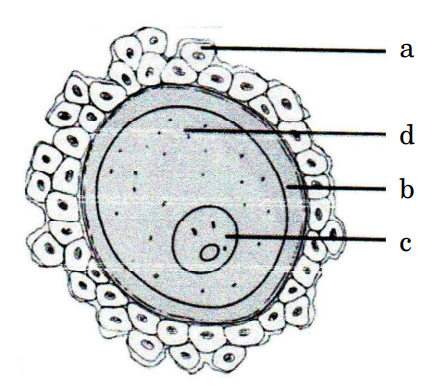
(a) Given below is a diagrammatic representation of a human ovum.
i) Identify the parts 'a', 'b' and 'c'.
ii) This ovum is released from the ovary with incomplete meiotic division. When, where and how is the meiotic division completed ?
iii) How does an ovum ensure the entry of a single sperm during fertilization ?
or
(b)
i) Double fertilization is an event unique to all flowering plants. Explain the process.
ii) Give a reason for the following :
1. A seed of an orange has many embryos.
2. Cashew is a false fruit but Guava is a true fruit.
Correct Answer :
(a)
i) a- Cells of corona radiata. b- Zona pellucida /Perivitelline space c- Haploid nucleus
ii)
• Once the sperm enters the cytoplasm of the ovum
• The whole process is completed within the fallopian tube.
• Entry of sperm in the cytoplasm of the ovum induces the completion of the 2nd meiotic division of the secondary oocyte, it is unequal division and results in formation of a second polar body and a haploid ovum(ootid).
iii) During fertilization as the sperm comes in contact with the zona pellucida layer of the ovum, it induces changes in the membrane, that block the entry of any additional sperms.
or
(b)
i)
• Double fertilisation is the occurrence of two types of fusion syngamy and triple fusion in an embryo sac of the angiosperm. • Syngamy- Fusion of one of the male gamete and the egg cell resulting in formation of a zygote (diploid).
• Triple fusion - Fusion of another male gamete with two haploid polar nuclei to produce a (triploid) primary endosperm nucleus. ii)
1. Some of the nucellar cells surrounding the embryo start dividing and protrude into the embryo sac to form embryos.
2. In case of Cashew thalamus also contribute in fruit formation along with ovary /development of fruit after fertilization from the part other than ovary, Guava fruit develops from the ovary after fertilization.
Solution :
Correct Answer / Explanation:
Part (a)
i) Identification of labeled parts in the human ovum diagram:
Based on the provided diagrammatic representation of a human ovum:
• 'a' represents the Cells of Corona Radiata: This is the outer protective layer of follicular cells surrounding the secondary oocyte.
• 'b' represents the Zona Pellucida / Perivitelline Space: The zona pellucida is the translucent, non-cellular glycoprotein membrane surrounding the oocyte, and the perivitelline space lies between the zona pellucida and the plasma membrane of the oocyte.
• 'c' represents the Haploid Nucleus: This is the nuclear region of the secondary oocyte carrying the maternal genetic material.
ii) Completion of the meiotic division:
• When: The meiotic division is completed only after the sperm makes contact and begins entering the cytoplasm of the ovum.
• Where: This process takes place within the fallopian tube (specifically in the ampulla region) where fertilization occurs.
��� How: The entry of the sperm into the cytoplasm of the ovum acts as a physiological trigger that induces the completion of the second meiotic division of the secondary oocyte. This division is highly unequal, resulting in the formation of a tiny second polar body and a larger haploid ovum (ootid).
iii) Ensuring monospermy (entry of a single sperm):
• During fertilization, as the first sperm comes in contact with the zona pellucida layer of the ovum, it induces depolarization and structural changes in the membrane. These biochemical modifications block the entry of any additional sperms, preventing polyspermy.
or
Part (b)
i) Process of Double Fertilization:
Double fertilization is a characteristic process unique to angiosperms (flowering plants) that involves two types of nuclear fusions within the embryo sac:
1. Syngamy: One of the haploid male gametes fuses with the haploid egg cell to form a diploid zygote. This zygote later develops into the embryo.
In genetic terms, the ploidy of the zygote is represented as:
2. Triple Fusion: The second haploid male gamete fuses with the diploid secondary nucleus (formed by the fusion of two haploid polar nuclei) to form a triploid primary endosperm nucleus (PEN). The PEN eventually develops into the endosperm, providing nutrition to the growing embryo.
The ploidy of the primary endosperm nucleus is represented as:
ii) Reasons for the biological observations:
1. An orange seed contains many embryos (Polyembryony): This occurs because some of the maternal nucellar cells surrounding the embryo sac actively divide, protrude directly into the embryo sac, and develop into multiple embryos alongside the zygotic embryo.
2. Cashew is a false fruit, whereas Guava is a true fruit:
• In the case of Cashew, the fleshy edible part is derived from the thalamus/pedicel (an accessory floral part other than the ovary) which actively participates in fruit formation.
• Conversely, a Guava fruit is classified as a true fruit because it develops exclusively from the mature ovary after successful fertilization has taken place.
Access expert-curated educational resources and study materials—completely free.
Create, conduct, and manage professional online assessments with Mindyard. Perfect for teachers and institutes.
Copyright © 2026 Mindyard. All Rights Reserved.
 Set - 3-1782888548748.webp)