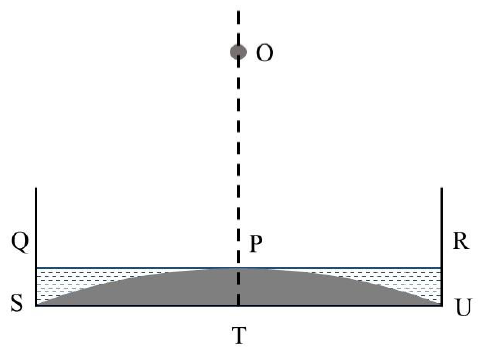
A glass beaker has a solid, plano-convex base of refractive index 1.60, as shown in the figure. The radius of curvature of the convex surface (SPU) is 9 cm, while the planar surface (STU) acts as a mirror. This beaker is filled with a liquid of refractive index 𝑛 up to the level QPR. If the image of a point object O at a height of ℎ (OT in the figure) is formed onto itself, then, which of the following option(s) is(are) correct?
Correct Answer :
For 𝑛 = 1.42, ℎ = 50 cm.
For 𝑛 = 1.35, ℎ = 36 cm.
Solution :
The correct options are:
1. For n = 1.42, h = 50 cm.
2. For n = 1.35, h = 36 cm.
Step-by-Step Explanation:
For the image of the point object O to form onto itself, the light rays originating from O must retrace their paths after reflecting from the planar mirror STU. Since STU is a flat horizontal mirror, the rays will retrace their paths if and only if they strike the mirror surface normally (i.e., perpendicular to STU, parallel to the principal axis OT).
Therefore, after refracting through the flat liquid surface QPR and the spherical liquid-glass interface SPU, the rays must become parallel to the principal axis (meaning the final image distance after the second refraction is at infinity).
By neglecting the thickness of the glass base at the apex (assuming the central thickness of the lens is very small, so that the distance from the liquid surface to the apex P is approximately 0, and OT ≈ OP = h), we can analyze the system as follows:
1. Refraction at the flat liquid surface QPR:
The ray travels from air (refractive index = 1) to the liquid (refractive index = n).
Using the refraction formula for a flat surface:
This virtual image serves as the object for the next refraction at the spherical boundary SPU.
2. Refraction at the spherical boundary SPU:
The boundary separates the liquid (refractive index ) and the glass base (refractive index ).
The radius of curvature of the convex surface SPU is R = +9 cm (using the standard sign convention with the pole at P, where downward directions are positive).
For the rays to become parallel to the principal axis, the image distance must be:
Applying the refraction formula for a spherical surface:
Substituting , , and R = 9 cm into the equation:
Simplifying the equation:
Thus, the relationship between h and n is:
Checking the options:
Case I: For n = 1.42
Substituting n = 1.42:
This matches the first option.
Case II: For n = 1.35
Substituting n = 1.35:
This matches the second option.
Access expert-curated educational resources and study materials—completely free.
Create, conduct, and manage professional online assessments with Mindyard. Perfect for teachers and institutes.
Copyright © 2026 Mindyard. All Rights Reserved.