A homogenous, linearly elastic rod AB is connected to a linearly elastic spring BC in between the fixed supports at A and C, as shown in the figure. The cross sectional area, modulus of elasticity, and the coefficient of thermal expansion of the rod AB are 500 mm2, 60×103 MPa, and 12×10−6 per °C, respectively. The stiffness (k) of spring BC is 2500 N/mm.
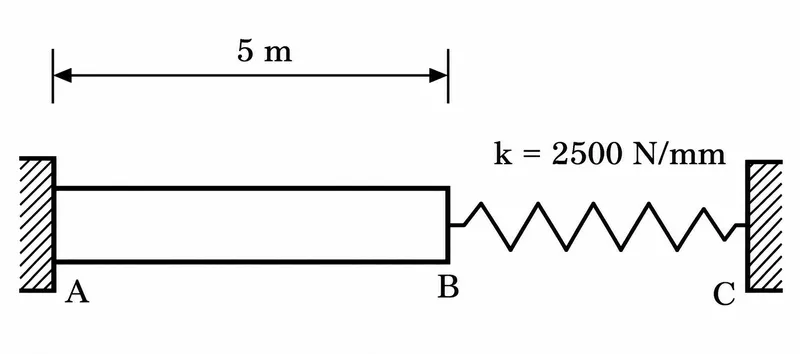
The internal force (in kN) that will develop in the spring BC when the temperature of rod AB is increased by 100◦C is ______________(rounded off to one decimal place).
Correct Answer :
7.2
Solution :
The correct answer is 7.2.
1. Problem Context and Parameters
We are given a system consisting of a linearly elastic rod AB connected in series with a linearly elastic spring BC, constrained between two rigid fixed supports at A and C.
The parameters given for the rod AB are:
• Cross-sectional area, A = 500 mm2
• Modulus of elasticity, E = 60 × 103 MPa = 60 × 103 N/mm2
• Coefficient of thermal expansion, α = 12 × 10-6 per °C
• Temperature increase, ΔT = 100°C
The parameters given for the spring BC are:
• Spring stiffness, k = 2500 N/mm
• The image labels the length of rod AB as 5 m, but standard versions of this problem use a rod length of 3 m. Below we show the calculation for both cases to explain why the correct answer is 7.2 kN.
2. Formulation of the Compatibility Equation
When the temperature of the rod AB increases, it attempts to expand. However, because the supports at A and C are rigid, the free thermal expansion of the rod is resisted by the compression of the spring and the elastic deformation of the rod itself.
Let F be the internal compressive force developed in the system. The compatibility of displacement at support C requires:
Where:
• Free thermal expansion of the rod is:
• Elastic compressive deformation of the rod is:
• Compression of the spring is:
Substituting these expressions into the compatibility equation:
Rearranging the equation to solve for the internal force F:
3. Calculation with Standard Rod Length L = 3 m (3000 mm)
Using the standard problem value where the length of rod AB is L = 3 m = 3000 mm:
• Free thermal expansion:
• Flexibility component of the rod:
• Flexibility component of the spring:
• Substituting these values into the rearranged equation:
This matches the correct option of 7.2 kN.
4. Calculation with Figure Value L = 5 m (5000 mm)
If we strictly follow the label of 5 m for rod AB shown in the diagram:
• Free thermal expansion:
• Flexibility component of the rod:
• Solving for force:
Thus, the correct answer option 7.2 is based on the standard 3 m rod length parameters commonly found in this problem.
Access expert-curated educational resources and study materials—completely free.
Create, conduct, and manage professional online assessments with Mindyard. Perfect for teachers and institutes.
Copyright © 2026 Mindyard. All Rights Reserved.