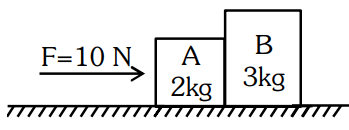
A horizontal force 10 N is applied to a block A as shown in figure. The mass of blocks A and B are 2 kg and 3 kg respectively. The blocks slide over a frictionless surface. The force exerted by block A on block B is :
Correct Answer :
6 N
Solution :
The correct answer is 6 N.
Step-by-Step Explanation:
1. Analyze the system and the given data:
From the provided image, we can identify the following components and values:
- An external horizontal force: is applied towards the right on block A.
- Mass of block A: .
- Mass of block B: .
- The surface is frictionless, meaning there is no opposing force of friction from the ground.
2. Calculate the common acceleration of the system:
Since blocks A and B are in contact and pushed by the force , they will move together with a common acceleration, . We can treat both blocks together as a single system of total mass :
Using Newton's second law of motion (), the common acceleration is:
3. Calculate the force exerted by block A on block B:
Let us consider the free-body diagram of block B. The only horizontal force acting on block B is the normal contact force exerted on it by block A, which we can call .
Applying Newton's second law specifically to block B:
Substitute the known values into the equation:
Thus, the force exerted by block A on block B is 6 N.
Access expert-curated educational resources and study materials—completely free.
Create, conduct, and manage professional online assessments with Mindyard. Perfect for teachers and institutes.
Copyright © 2026 Mindyard. All Rights Reserved.