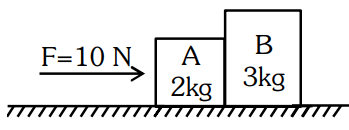
A horizontal force 10 N is applied to a block A as shown in figure. The mass of blocks A and B are 2 kg and 3 kg, respectively. The blocks slide over a frictionless surface. The force exerted by block A on block B is :
Correct Answer :
6N
Solution :
**Correct answer:** 6 N
The diagram (see the provided image) shows two blocks, A (2 kg) and B (3 kg), placed side‑by‑side on a frictionless horizontal surface. A horizontal force of 10 N is applied to block A, pushing both blocks together.
Since the surface is frictionless, the only external horizontal force on the system is the 10 N applied to block A. The two blocks move as a single system with a common acceleration .
Using Newton’s second law for the whole system:
where Fext = 10 N and mtotal = mA + mB = 2 kg + 3 kg = 5 kg.
Calculate the acceleration:
Now consider block B alone. The only horizontal force acting on block B is the contact force exerted by block A, which we denote as FAB. Applying Newton’s second law to block B:
Substituting mB = 3 kg and a = 2 m/s²:
Therefore, the force that block A exerts on block B is **6 N**.
Access expert-curated educational resources and study materials—completely free.
Create, conduct, and manage professional online assessments with Mindyard. Perfect for teachers and institutes.
Copyright © 2026 Mindyard. All Rights Reserved.