(a)
i) Describe the arrangement of nuclei and cells in a mature embryo sac of a typical angiosperm.
ii) Explain the devices the flowering plants have developed to prevent the following types of pollination :
1. Prevents both autogamy and geitonogamy
2. Prevents autogamy, but not geitonogamy
(b)
i) Write the specific location of the following in the testis in humans :
1. Sertoli cells
2. Leydig cells
ii) Explain the coordination between Gonadotropins, Leydig cells and Sertoli cells and their role in spermatogenesis.
Correct Answer :
(a)
i)
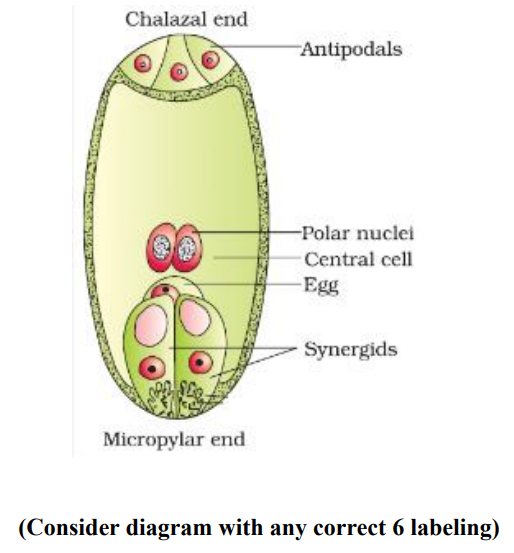
A typical angiospermic embryo sac is 7 celled and 8 nucleated, three cells are grouped together at the micropylar end to constitute the egg apparatus, egg apparatus has two synergids, and one egg cell, three cells are at the chalazal end and are called antipodals, the seventh cell is the large central cell with two polar nuclei.
//
ii)
1. Male and Female flowers are present on different plants (dioecy)/ Self incompatibility
2. Production of unisexual flowers by the plant/ both male and female flowers are present on the same plant/Monoecious / non synchronization of pollen release and stigma receptivity/ Anther and stigma are placed at different positions ( Herkogamy)
or
(b)
i)
1. Within seminiferous tubule
2. In interstitial spaces / between the seminiferous tubules
ii)
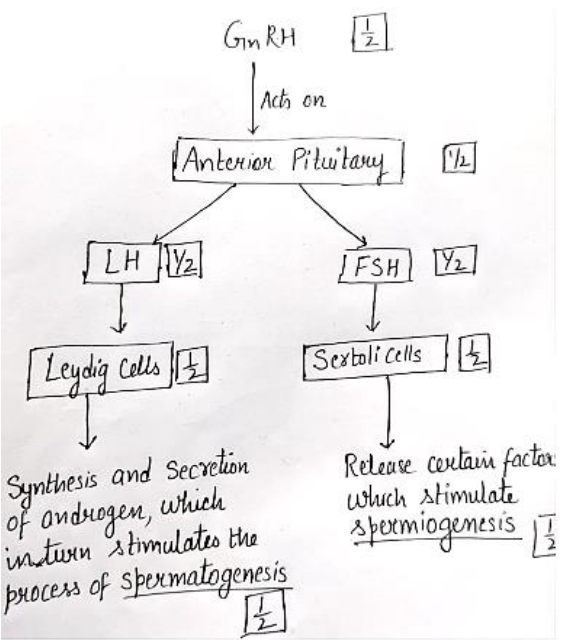
//
The increased levels of GnRH, then acts at the anterior pituitary gland, and stimulates secretion of two gonadotropins – luteinising hormone (LH), and follicle stimulating hormone (FSH), LH acts at the Leydig cells, and stimulates synthesis and secretion of androgens which in turn stimulate the process of spermatogenesis, FSH acts on the Sertoli cells, and stimulates secretion of some factors which help in the process of spermiogenesis.
Solution :
Correct Answer/Option:
(a)
i) A typical angiospermic embryo sac is 7-celled and 8-nucleated. Three cells are grouped together at the micropylar end to constitute the egg apparatus (which consists of two synergids and one egg cell), three cells are at the chalazal end and are called antipodals, and the seventh cell is the large central cell with two polar nuclei.
ii)
1. Male and female flowers are present on different plants (dioecy) or self-incompatibility.
2. Production of unisexual flowers by the plant where both male and female flowers are present on the same plant (monoecious), non-synchronization of pollen release and stigma receptivity, or positioning of the anther and stigma at different heights/locations (herkogamy).
or
(b)
i)
1. Sertoli cells: Within the seminiferous tubules.
2. Leydig cells: In the interstitial spaces / between the seminiferous tubules.
ii) The increased levels of GnRH act on the anterior pituitary gland, stimulating the secretion of two gonadotropins: Luteinizing Hormone (LH) and Follicle-Stimulating Hormone (FSH). LH acts on Leydig cells to stimulate the synthesis and secretion of androgens, which in turn stimulate spermatogenesis. FSH acts on Sertoli cells to stimulate the secretion of factors that assist in spermiogenesis.
Detailed Step-by-Step Explanation:
Part (a) (i): Structure of a Mature Embryo Sac
Based on the anatomical details represented in Image 0, a mature embryo sac of a typical angiosperm (Polygonum type) undergoes three consecutive mitotic divisions to form a structure that is 7-celled but contains 8 nuclei. The cellular arrangement is as follows:
1. Egg Apparatus (Micropylar End): Located at the bottom or micropylar region (labeled as Micropylar end in the image), it consists of three cells: two lateral synergids and one central egg cell.
2. Antipodal Cells (Chalazal End): Located at the opposite end (labeled as Chalazal end and Antipodals in the image), these are three chalazal cells that serve nutritive functions before degenerating.
3. Central Cell: The remaining largest cell in the middle (labeled as Central cell) contains two distinct polar nuclei (labeled as Polar nuclei) that eventually fuse to form the diploid secondary nucleus.
Part (a) (ii): Outbreeding Devices preventing Pollination Types
Flowering plants have evolved several mechanisms to promote cross-pollination and avoid the genetic disadvantages of inbreeding:
1. Prevention of both Autogamy (self-pollination within the same flower) and Geitonogamy (pollination between different flowers of the same plant):
This requires the male and female reproductive systems to be entirely separated on different individuals (Dioecy), meaning a single plant is either strictly male or female. Alternatively, genetic mechanisms like Self-incompatibility prevent pollen from germinating on the stigma of the same flower or other flowers on the same plant.
2. Prevention of Autogamy, but not Geitonogamy:
This is achieved by Monoecy, where unisexual male and female flowers are borne on the same plant (preventing autogamy since individual flowers are unisexual, but allowing geitonogamy between different flowers of the same plant). Other methods include Dichogamy (non-synchronization where pollen release and stigma receptivity happen at different times) and Herkogamy (spatial separation where anthers and stigmas are physically located at different heights or orientations, preventing self-pollination within the same flower).
Part (b) (i): Location of Cells in the Human Testis
1. Sertoli Cells: These large, elongated supporting cells are located within the seminiferous tubules of the testis, lining the inner tubule walls to provide structural and nutritional support to developing sperm cells.
2. Leydig Cells (Interstitial Cells): These endocrine cells are situated in the connective tissue spaces outer to the tubules, known as the interstitial spaces / between the seminiferous tubules.
Part (b) (ii): Hormonal Coordination in Spermatogenesis
As visualized in the flowchart in Image 1, the process of male gamete production is highly regulated by a coordinated hormonal feedback loop:
1. Hypothalamic Stimulus: The hypothalamus releases Gonadotropin-Releasing Hormone (GnRH).
2. Anterior Pituitary Activation: GnRH acts on the anterior pituitary gland, triggering it to synthesize and release two key gonadotropic hormones: Luteinizing Hormone (LH) and Follicle-Stimulating Hormone (FSH).
3. Leydig Cell Pathway: LH binds to receptors on the Leydig cells, stimulating them to synthesize and secrete male sex hormones, primarily testosterone (androgens). These androgens are critical for stimulating the overall process of spermatogenesis (sperm production).
4. Sertoli Cell Pathway: FSH acts directly on the Sertoli cells, inducing them to secrete key regulatory factors (such as androgen-binding protein and inhibin) that are essential for facilitating spermiogenesis (the final transformation of spermatids into mature, motile spermatozoa).
Access expert-curated educational resources and study materials—completely free.
Create, conduct, and manage professional online assessments with Mindyard. Perfect for teachers and institutes.
Copyright © 2026 Mindyard. All Rights Reserved.
 Set - 3-1782888548748.webp)