(a)
i) Describe the phenomenon of adaptive radiation as explained by Darwin.
ii) Is human evolution an example of adaptive radiation ?
Give reason in support of your answer.
or
(b) You are given a tall pea plant and asked to determine its genotype. Name and explain the cross that you will carry out to find the possible genotype of the given tall pea plant.
Correct Answer :
(a)
i)
• Many varieties of finches (black bird) were found on the island (Galapagos)
• Originally all birds had seed eating features
• Gradually as they moved to other geographical areas
• The beak structures changed according to the food available there and many other altered beaks arose.
• Some becoming insectivorous and others remaining vegetarian
• Hence the process of evolution starting from a point and radiating to other areas of habitats is called adaptive radiation.
ii)
• No
• Human evolution is an example of progressive evolution and not adaptive radiation, parent species of Homosapiens have evolved from Homo habilis and to homo erectus lineage.
or
(b) Test cross Genotype of tall plant can be TT or Tt
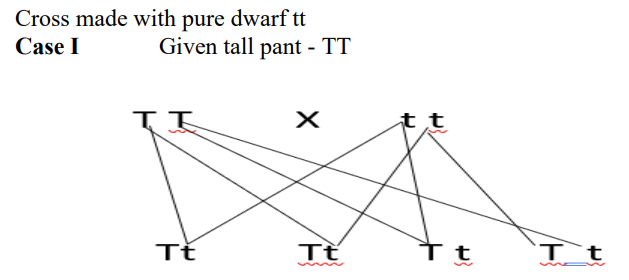
If the genotype of the tall pea plant (given) was TT. Then the phenotype of all plant of this cross = 100% Tall
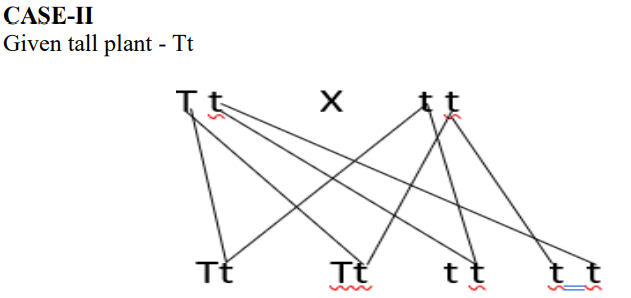
If the genotype of the tall pea plant (given) was Tt Then phenotype of plant in this cross = 50 % Tall
50 % Dwarf
Solution :
Correct Answer / Solution:
(a)
i) Adaptive Radiation:
During his journey to the Galápagos Islands, Charles Darwin observed an amazing diversity of small black birds, now known as Darwin's finches. He noticed that:
• Originally, all these finches possessed seed-eating beak features, indicating a common ancestral stock.
• As they migrated and spread to different geographical areas and ecological niches on the islands, they faced different environmental pressures and food sources.
• Consequently, their beak structures gradually modified over generations to suit the food available in their respective new habitats.
• This led to the development of diverse beak shapes: some evolved to become insectivorous (insect-eating) with slender beaks, while others remained vegetarian with crushing beaks suited for fruits or seeds.
• This evolutionary process—where a single ancestral species radiates and diversifies into multiple different species occupying different ecological habitats—is called adaptive radiation.
ii) Human Evolution:
• No, human evolution is not an example of adaptive radiation.
• Reason: Human evolution is primarily an example of progressive (linear) evolution rather than adaptive radiation. Instead of radiating from a single point into multiple coexisting species adapting to different niches, the lineage leading to modern humans (Homo sapiens) occurred sequentially. Specifically, the parent species evolved chronologically along a lineage, from Homo habilis to Homo erectus, and eventually giving rise to Homo sapiens.
or
(b) Determining Genotype via a Test Cross:
To determine the genotype of a tall pea plant, which can be either homozygous dominant (TT) or heterozygous (Tt), we carry out a test cross. In a test cross, the given dominant phenotype plant is crossed with a homozygous recessive parent, which is a pure dwarf pea plant (tt).
Based on the provided cross diagrams, we analyze two distinct cases to determine the genotype:
Case I (Visible in Image 0 - "Case I Given tall plant - TT" crossed with "pure dwarf tt"):
If the given tall pea plant is homozygous dominant (TT), then all the gametes it produces will carry the dominant allele T. The pure dwarf plant (tt) only produces gametes carrying the recessive allele t.
• Cross: TT × tt
• Offspring Genotypes: All offspring are Tt (heterozygous tall).
• Offspring Phenotype: 100% Tall.
Therefore, if 100% of the progeny are tall, the genotype of the given tall plant is confirmed to be TT.
Case II (Visible in Image 1 - "CASE-II Given tall plant - Tt" crossed with "pure dwarf tt"):
If the given tall pea plant is heterozygous (Tt), it produces two types of gametes in equal proportions: 50% carrying the dominant allele T and 50% carrying the recessive allele t. The dwarf parent (tt) produces only t gametes.
• Cross: Tt × tt
• Offspring Genotypes: 50% Tt and 50% tt.
• Offspring Phenotype: 50% Tall and 50% Dwarf (a 1:1 ratio).
Therefore, if the progeny consists of both tall and dwarf plants in an equal ratio, the genotype of the given tall plant is confirmed to be Tt.
Access expert-curated educational resources and study materials—completely free.
Create, conduct, and manage professional online assessments with Mindyard. Perfect for teachers and institutes.
Copyright © 2026 Mindyard. All Rights Reserved.
 Set - 3-1782888548748.webp)