(a)
i) Draw a labelled diagram of a replication fork in a prokaryote indicating the process of DNA replication.
ii) Differentiate between the two newly synthesised DNA strands within the fork.
iii) Name the enzymes involved in the process of DNA replication.
(iv) Name the eukaryote where the semi-conservative mode of replication was experimentally proved.
or
(b) You are given a tall pea plant with green seeds. The genotype of this plant is unknown. You are allowed to do 'selfing' of these plants to find out the genotype of the given plant. Work out all possible crosses and show how you would determine the genotype of the given plant.
Correct Answer :
(a)
i)
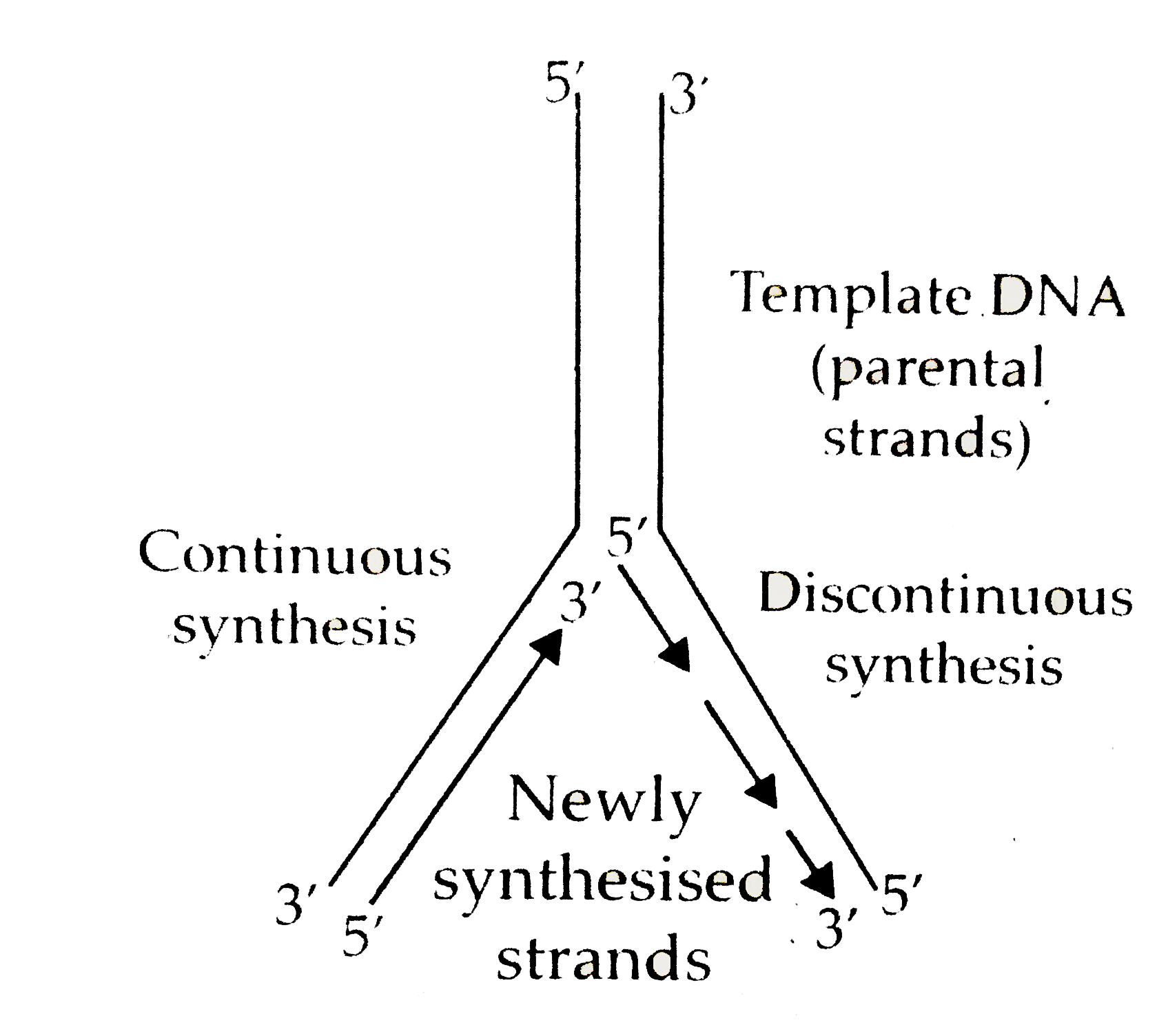
Template strand (Parental strand), Continuous synthesis, Leading strand, discontinuous synthesis, Lagging strand/Okazaki fragments, Newly synthesized strands, arrow showing the direction of replication(Polarity)
ii) Parental strand with polarity 5’-3’ shows discontinuous synthesis while Parental strand with polarity 3’-5’ shows continuous synthesis.
iii) DNA dependent DNA polymerase, ligase, Helicase, Topoisomerase, Primase ( any two)
iv) Vicia faba /Faba bean
or
(b)Possible genotype: TTyy and Ttyy
Case-1 TTyy X TTyy
Gamete: Ty, Ty
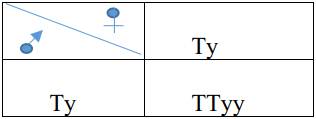
Phenotype of F1- All tall pea plants with green seeds
Conclusion: Given plant is homozygous dominant for plant height and homozygous recessive for seed colour(TTyy)
Case-12 Ttyy X Ttyy
Gamete: Ty, Ty
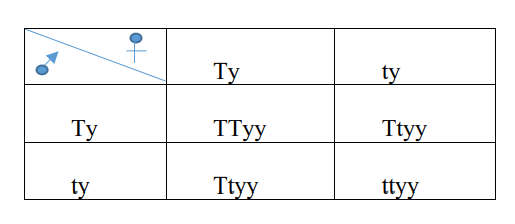
Phenotype of F1- Tall green : Dwarf green
3 : 1
Conclusion: Given plant is heterozygous for plant height and homozygous recessive for seed colour(Ttyy).
Solution :
The provided correct answer outlines the solutions for both alternative parts: Part (a) regarding DNA replication, and Part (b) regarding the determination of the genotype of a tall pea plant with green seeds via selfing.
i) Labelled Diagram of a Replication Fork:
The replication fork (as shown in the replication diagram) represents the Y-shaped structure formed during DNA replication when helicase unwinds the double helix.
• Template Strands (Parental Strands): The two parental strands run antiparallel to each other. One template strand has a polarity of 3' → 5' (on the left in the diagram), while the other has a polarity of 5' → 3' (on the right in the diagram).
• Continuous Synthesis (Leading Strand): DNA polymerase can only synthesize new DNA in the 5' → 3' direction. Therefore, replication on the 3' → 5' template strand occurs continuously towards the replication fork.
• Discontinuous Synthesis (Lagging Strand): Replication on the 5' → 3' template strand occurs discontinuously, moving away from the fork. This produces short segments of DNA called Okazaki fragments, which are later joined together.
• Newly Synthesized Strands: These are the daughter strands showing the polarity and directions of synthesis (indicated by the directional arrows).
ii) Differentiation between the two newly synthesized DNA strands:
• Leading Strand (Continuous Synthesis): The parental template strand with 3' → 5' polarity guides the continuous synthesis of the leading strand in the 5' → 3' direction towards the replication fork.
• Lagging Strand (Discontinuous Synthesis): The parental template strand with 5' → 3' polarity guides the discontinuous synthesis of the lagging strand (composed of Okazaki fragments) in the 5' → 3' direction away from the replication fork.
iii) Enzymes involved in DNA replication:
The major enzymes involved in this process include:
• DNA-dependent DNA Polymerase: Synthesizes the new DNA strand by adding complementary nucleotides.
• DNA Ligase: Joins the Okazaki fragments on the lagging strand by sealing phosphodiester bonds.
• DNA Helicase: Unwinds the double-stranded DNA helix at the replication fork.
• Topoisomerase (DNA Gyrase): Relieves the torsional strain/tension caused by unwinding.
• Primase: Synthesizes short RNA primers required to initiate DNA synthesis.
iv) Experimental proof of semi-conservative replication in Eukaryotes:
The semi-conservative mode of DNA replication in eukaryotes was experimentally proven by Taylor et al. in 1958 using radioactive thymidine in the root tip cells of Vicia faba (Faba bean).
We are given a tall pea plant with green seeds.
In pea plants, tallness (T) is dominant over dwarfness (t), and yellow seed color (Y) is dominant over green seed color (y). Since green seed color is a recessive trait, a green-seeded plant must always be homozygous recessive (yy).
Therefore, the unknown genotype of the tall, green-seeded plant can be either:
1. Homozygous dominant for height: TTyy
2. Heterozygous for height: Ttyy
We perform self-pollination (selfing) to determine the exact genotype.
Case 1: If the genotype of the given plant is TTyy (Homozygous Tall, Green)
When selfed: TTyy × TTyy
• Gametes: All gametes produced by both parents will carry the alleles Ty.
• Punnett Square Analysis:
| Gametes | Ty |
|---|---|
| Ty | TTyy |
• F1 Phenotype: 100% Tall pea plants with green seeds.
• Conclusion: If all offspring in the F1 generation are tall with green seeds, the parent plant is homozygous dominant for height (TTyy).
Case 2: If the genotype of the given plant is Ttyy (Heterozygous Tall, Green)
When selfed: Ttyy × Ttyy
• Gametes: Each parent produces two types of gametes in equal proportion: Ty and ty.
• Punnett Square Analysis:
| Gametes | Ty | ty |
|---|---|---|
| Ty | TTyy (Tall Green) |
Ttyy (Tall Green) |
| ty | Ttyy (Tall Green) |
ttyy (Dwarf Green) |
• F1 Phenotypes and Ratio:
- Tall green plants: TTyy + Ttyy + Ttyy = 3/4 (75%)
- Dwarf green plants: ttyy = 1/4 (25%)
- Phenotypic ratio = 3 Tall Green : 1 Dwarf Green
• Conclusion: If the F1 generation contains both tall green and dwarf green plants in a 3:1 ratio, the parent plant is heterozygous for height (Ttyy).
Access expert-curated educational resources and study materials—completely free.
Create, conduct, and manage professional online assessments with Mindyard. Perfect for teachers and institutes.
Copyright © 2026 Mindyard. All Rights Reserved.
 Set - 3-1782888548748.webp)