(a) i) Expand the abbreviations given below, used for different modes of assisted reproductive technologies :
1. ZIFT
2. ICSI
3. IUT
4. GIFT
(ii) Which one of them cannot be considered as a procedure of IVF ? Give reasons in support of your answer.
or
(b) Differentiate between the following :
i) Perisperm and Pericarp
ii) Syncarpous pistil and Apocarpous pistil
iii) Plumule and Radicle
Correct Answer :
(a)
i)
1. ZIFT : Zygote intrafallopian transfer.
2. ICSI : Intracytoplasmic sperm injection.
3. IUT : Intra uterine transfer.
4. GIFT : Gamete intrafallopian transfer.
ii)
• GIFT
• GIFT allows the eggs to fertilize and develop in the fallopian tube/ IVF places a directly fertilized egg (zygote) into the uterus/ in vivo fertilization is involved in GIFT.
or
Solution :
Correct Answer:
(a)
i) Abbreviations:
1. ZIFT: Zygote intrafallopian transfer.
2. ICSI: Intracytoplasmic sperm injection.
3. IUT: Intra uterine transfer.
4. GIFT: Gamete intrafallopian transfer.
ii) Exclusion from IVF: GIFT cannot be considered an IVF (In Vitro Fertilization) procedure because in GIFT, in vivo (inside the body) fertilization occurs. Gametes (eggs and sperm) are transferred directly into the fallopian tube, allowing fertilization and subsequent development to take place naturally inside the female's body.
OR
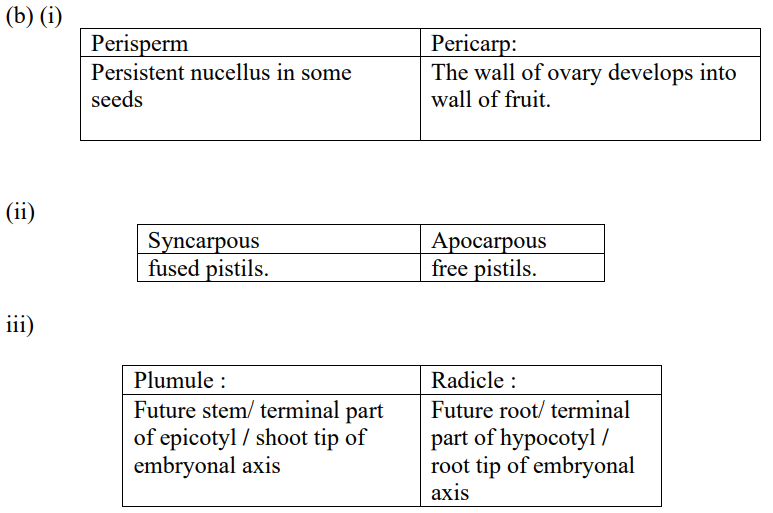
(b) Differences (as visible in the provided image):
i) Perisperm vs. Pericarp:
• Perisperm: It is the persistent nucellus present in some seeds.
• Pericarp: It is the wall of the fruit, which develops from the ovary wall.
ii) Syncarpous vs. Apocarpous pistil:
• Syncarpous: The pistils (carpels) are fused together.
• Apocarpous: The pistils (carpels) remain free.
iii) Plumule vs. Radicle:
• Plumule: The future stem, the terminal part of the epicotyl, or the shoot tip of the embryonal axis.
• Radicle: The future root, the terminal part of the hypocotyl, or the root tip of the embryonal axis.
---
Detailed Step-by-Step Educational Explanation:
Part (a) Breakdown:
1. Understanding Assisted Reproductive Technologies (ART): ART includes a range of medical procedures used to address infertility. Knowing the precise terminology helps identify the site of fertilization and transfer:
• ZIFT (Zygote Intrafallopian Transfer): In this method, the egg is fertilized by sperm in a laboratory (in vitro). The resulting zygote (up to the 8-blastomere stage) is then transferred directly into the fallopian tube.
• ICSI (Intracytoplasmic Sperm Injection): A specialized laboratory procedure where a single sperm is injected directly into an egg to assist fertilization in vitro.
• IUT (Intrauterine Transfer): An embryo with more than 8 blastomeres is transferred directly into the uterus to complete its development.
• GIFT (Gamete Intrafallopian Transfer): This involves harvesting eggs from a donor or mother, mixing them with sperm, and immediately placing them into the fallopian tubes.
2. Why GIFT is not IVF: In IVF, fertilization occurs outside the body (in vitro) in a laboratory dish. Since GIFT transfers unfertilized gametes (eggs and sperm) directly into the fallopian tube, fertilization takes place inside the mother's body (in vivo). Hence, GIFT is an in vivo fertilization technique rather than an in vitro one.
Part (b) Breakdown (Analyzing the Image Data):
1. Perisperm vs. Pericarp: The nucellus is the central nutritive tissue of the ovule. In most seeds, it is completely consumed during embryo development. However, in some seeds (like black pepper and beet), a remnant of the nucellus persists, which is called the perisperm. On the other hand, after fertilization, the ovary wall matures into the fruit wall, which is known as the pericarp.
2. Syncarpous vs. Apocarpous Pistils: The gynoecium represents the female reproductive part of a flower and may consist of one or more carpels (pistils). When there are multiple carpels and they are fused together into a single unit, the condition is syncarpous (e.g., mustard, tomato). When the carpels remain distinct and free from one another, the condition is apocarpous (e.g., lotus, Michelia).
3. Plumule vs. Radicle: During seed germination, the embryonal axis differentiates to form the root and shoot systems. The plumule is the region at the tip of the epicotyl (the region of the embryonal axis above the cotyledons) that develops into the future stem and leaves. The radicle is located at the lower end of the hypocotyl (the region below the cotyledons) and develops into the future root system.
Access expert-curated educational resources and study materials—completely free.
Create, conduct, and manage professional online assessments with Mindyard. Perfect for teachers and institutes.
Copyright © 2026 Mindyard. All Rights Reserved.
 Set - 3-1782888548748.webp)