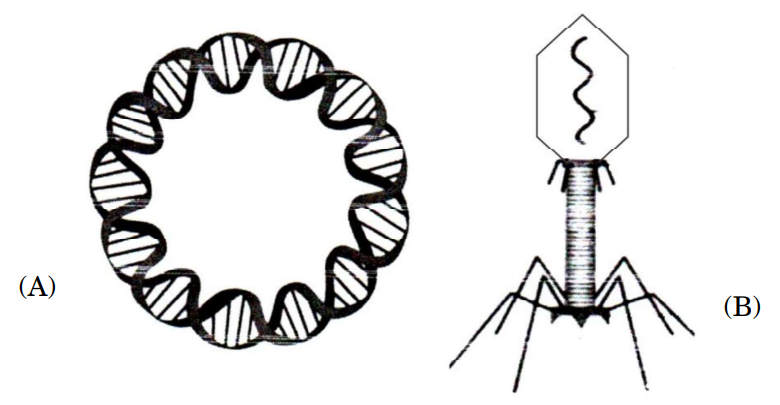
(a) i) Identify and name the structures 'A' and 'B' marked in the image given below :
ii) State their importance in various biotechnology experiments.
or
(b) Explain the process by which a bacterial cell can be made divalent cations and temperature treatment.
Correct Answer :
(a)
i) ‘A; Circular DNA/Plasmid ‘B’ Bacteriophage
ii) (Plasmid)-Can carry foreign gene into the host cell/acts as cloning vector/has selectable marker/ independent of the control of chromosomal DNA/ high copy number. (Bacteriophage) -Cloning vector have the ability to replicate in bacterial cells / independent of the control of chromosomal DNA / high copy number per cell.
or
(b) Treating bacteria with specific concentration of calcium (ions) which increases the efficiency with which DNA enters the bacteria through pores in its cell wall ,recombinant DNA can then be forced into such cells by incubating the cells with recombinant DNA on ice, followed by placing them briefly at 42°C (heat shock), then putting them back on ice.
Solution :
Correct Answer:
(a)
i) Structure 'A' is Circular DNA/Plasmid, and Structure 'B' is Bacteriophage.
ii)
Step-by-Step Educational Explanation:
Part (a) i): Identification of the Structures from the Image
By analyzing the provided illustration:
Part (a) ii): Importance in Biotechnology Experiments
Both plasmids and bacteriophages are widely utilized in recombinant DNA technology as cloning vectors:
Part (b): Making Host Cells Competent via Divalent Cations and Heat Shock
DNA is a hydrophilic molecule and cannot easily pass through the hydrophobic lipid bilayer of cell membranes. To force bacterial cells to take up foreign plasmid DNA, they must be made "competent" using the following chemical and thermal treatments:
1. Divalent Cation Treatment: The bacterial cells are treated with a specific concentration of divalent cations, most commonly calcium
ions. The positively charged calcium ions neutralize the negative charges on both the phosphate backbone of the DNA and the lipopolysaccharides in the bacterial outer membrane. This charge neutralization brings the DNA in close proximity to the cell wall pores.
2. Incubation on Ice: The host cells and recombinant DNA are incubated together on ice, allowing the DNA to adsorb stably onto the cell surface.
3. Heat Shock Treatment: The mixture is briefly exposed to a temperature of
for about 30 to 90 seconds. This sudden increase in temperature alters the permeability of the bacterial cell membrane, creating transient thermal pores that allow the DNA to enter the cytosol.
4. Recovery on Ice: The cells are quickly returned to ice to restore membrane integrity, trapping the internalized recombinant DNA inside the cell.
Access expert-curated educational resources and study materials—completely free.
Create, conduct, and manage professional online assessments with Mindyard. Perfect for teachers and institutes.
Copyright © 2026 Mindyard. All Rights Reserved.
 Set - 3-1782888548748.webp)