(a)
i) When and how does foetal ejection reflex begin ?
ii) Pituitary gland and uterine muscles play an important role during parturition. Explain.
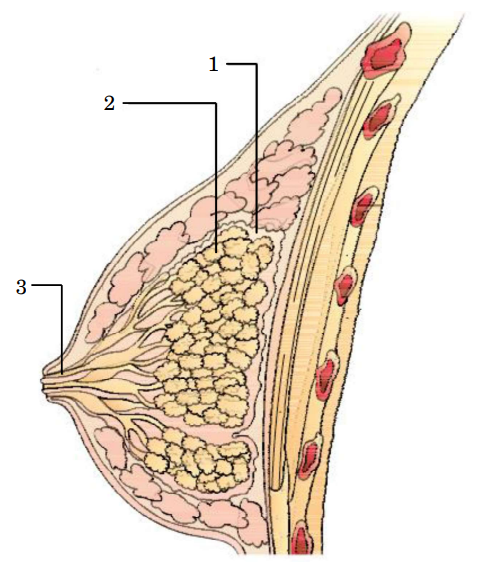
iii) A functional mammary gland is a characteristic of all female mammals. Given below is a diagrammatic sectional view of a mammary gland. Identify the parts 1, 2 and 3, and mention one function of each of them.
or
(b)
i) How are the characteristic features of pollen, anther and stigma of a maize plant suited for pollination by wind ?
ii) How do you justify that :
1. Pollen grains are recovered from fossils ?
2. Micropyle remains as a small pore in the seed coat of a fully developed seed ?
Correct Answer :
(a)
i)
• When foetus is fully mature/ after completion of gestation periods / after completion of pregnancy
• Mild uterine contractions originate in response to the signal from a fully developed foetus and placenta.
ii) Foetal ejection reflex triggers a release of oxytocin from the maternal pituitary, oxytocin acts on uterine muscles and causes contractions and expulsion of baby out of the uterus.
iii)
1 - Mammary lobes, has clusters of cells called alveoli.
2 - Mammary alveolus, secrete milk.
3 - Lactiferous duct, through this milk is sucked out.
or
(b)
i)
• Pollen- light / non-sticky, to travel easily through air
//
Produce in enormous amount, to compensate the wastage during pollination
• Anther –well exposed, pollen easily dispersed into wind current.
• Stigma –Large / often feathery, to easily trap air-borne pollen grains.
ii)
1. Pollen grains have hard outer layer exine made up of sporopollenin, which is one of the most resistant organic material known / no enzyme can degrade sporopollenin.
2. It allows the entry of water, oxygen into the seed at the time of germination.
Solution :
Correct Answer / Solution:
(a)
i) The foetal ejection reflex begins when the foetus is fully mature (at the completion of the gestation period/pregnancy). Mild uterine contractions originate in response to hormones and signals released by the fully developed foetus and the placenta.
ii) During parturition, the foetal ejection reflex triggers the release of oxytocin from the maternal posterior pituitary gland. Oxytocin acts on the uterine smooth muscles, causing them to contract. These contractions stimulate further secretion of oxytocin in a positive feedback loop, leading to progressively stronger contractions and the eventual expulsion of the baby from the uterus.
iii) Based on the diagrammatic sectional view of the mammary gland:
• 1 - Mammary lobe: A glandular tissue compartment (15–20 per breast) containing clusters of secretory cells called alveoli.
• 2 - Mammary alveolus: Sac-like structures where the cells secrete milk and store it in their cavities (lumens).
• 3 - Lactiferous duct: The final duct through which milk is channeled and sucked out.
OR
(b)
i) Suitability of maize plants for wind pollination (anemophily):
• Pollen grains: Light and non-sticky to travel easily through air currents. They are produced in enormous numbers to compensate for wastage during wind dispersal.
• Anther: Well-exposed (exserted) to allow pollen to be easily shaken off and dispersed into wind currents.
• Stigma: Large and feathery to increase surface area for trapping air-borne pollen grains.
ii) Justifications:
• 1. Pollen grains are well-preserved as fossils because their outer layer, the exine, is composed of sporopollenin, which is one of the most resistant biological materials known. It resists high temperatures, strong acids, alkalis, and cannot be degraded by any known enzyme.
• 2. The micropyle remains as a small pore in the mature seed coat because it acts as a passage to allow the entry of water and oxygen into the seed, which are essential for cellular respiration and metabolic activation during seed germination.
Detailed Step-by-Step Educational Breakdown:
1. Understanding Parturition & the Foetal Ejection Reflex (Part a)
Parturition (childbirth) is induced by a complex neuroendocrine mechanism. The signals for child birth originate from the fully developed foetus and the placenta, which induce mild uterine contractions called the foetal ejection reflex.
This reflex travels via neural pathways to the maternal hypothalamus, prompting the posterior pituitary gland to release oxytocin. Oxytocin is a powerful hormone that target-binds to receptors on the uterine myometrium (uterine muscles), causing them to contract. Each contraction sends sensory feedback to release even more oxytocin. This positive feedback cycle intensifies uterine contractions until the baby is pushed through the birth canal (expelled out of the uterus).
2. Anatomy of the Mammary Glands (Part a - iii)
The mammary glands are paired structures containing glandular tissue and variable amounts of fat. Analyzing the provided diagrammatic cross-section:
• Label 1 points to the structural compartments known as mammary lobes. Each gland has 15–20 of these lobes, which contain the milk-producing units.
• Label 2 points to an individual mammary alveolus (plural: alveoli). The cells lining these alveoli are responsible for synthesizing and secreting milk under the influence of prolactin.
• Label 3 points to the lactiferous duct located at the nipple. Milk flows from the alveoli into mammary tubules, then into mammary ducts, which expand into mammary ampullae before opening into the lactiferous ducts to allow nursing.
3. Wind Pollination Adaptations in Maize (Part b - i)
Maize is wind-pollinated, which is a non-directional, passive process. To ensure reproductive success, the plant exhibits specific morphological adaptations:
• Since wind cannot target specific flowers, pollen must be light, dry, and non-sticky so that it does not clump together and can drift on gentle breezes. Overproduction of pollen compensates for the vast majority of grains that never reach a female flower.
• Anthers are versatile and dangle outside the flower, exposing them directly to air currents.
• The female flowers produce long, feathery tassels (the stigmas and styles) that wave in the wind, acting as a net to capture passing pollen grains.
4. Pollen Durability and Seed Structure (Part b - ii)
• Sporopollenin: The exine layer of a pollen grain consists of sporopollenin, a highly cross-linked polymer of fatty acids and phenolics. Its extreme chemical inertness prevents microbial decomposition and chemical weathering, allowing pollen to remain structurally intact in geological strata for millions of years.
• Micropyle: While the integuments of the ovule harden to form a protective seed coat (testa), a tiny opening called the micropyle is left unsealed. Without this pore, the dormant embryo inside the seed would suffocate and dehydrate, as it provides the sole route for absorbing the moisture and oxygen needed to break dormancy and begin growing.
Access expert-curated educational resources and study materials—completely free.
Create, conduct, and manage professional online assessments with Mindyard. Perfect for teachers and institutes.
Copyright © 2026 Mindyard. All Rights Reserved.
 Set - 3-1782888548748.webp)