(a) IVF is a very popular method these days that is helping childless couples to bear a child. Describe the different steps that are carried out in this technique
(b) Would you consider Gamete Intrafallopian Transfer (GIFT) as an IVF ? Give a reason in support of your answer.
or
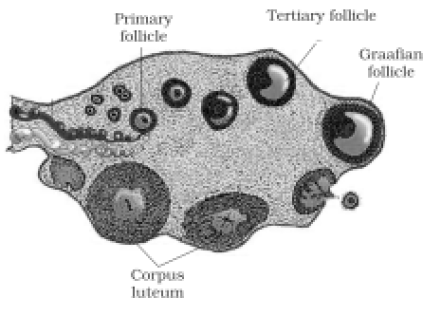
(a) Draw a sectional view of a human ovary and label primary follicle, tertiary follicle, Graafian follicle and corpus luteum in it.
(b) Name the gonadotropins and explain their role in oogenesis andthe release of ova.
Correct Answer :
(a) Ova from the wife /donor (female) and sperms from the husband / donor (male ) , are collected and induced to form zygote , in simulated conditions in laboratory , the zygote/ early embryos(upto 8 blastomeres) then transferred into the fallopian tube(ZIFT), and embroyos with more than 8 blastomeres, into the uterus(IUT) to complete its further development.
(b) No, GIFT cannot be considered as IVF technique because fertilisation takes place in the female body / in vivo
or
(a)
(b) Gonadotropins- LH and FSH
As they stimulate follicular development and helps in secretion of estrogen by the growing follicle.
Solution :
Correct Answer / Option:
First Option Set:
(a) Ova from the wife / donor (female) and sperms from the husband / donor (male) are collected and induced to form a zygote in simulated conditions in the laboratory. The zygote/early embryo (up to 8 blastomeres) is then transferred into the fallopian tube (ZIFT), and embryos with more than 8 blastomeres are transferred into the uterus (IUT) to complete further development.
(b) No, GIFT cannot be considered as an IVF technique because fertilization takes place inside the female body (in vivo).
OR Option Set:
(a) Sectional view of a human ovary showing labeled parts: Primary follicle, Tertiary follicle, Graafian follicle, and Corpus luteum.
(b) Gonadotropins: Luteinizing Hormone (LH) and Follicle Stimulating Hormone (FSH). They stimulate follicular development and help in the secretion of estrogen by the growing follicle.
Detailed Step-by-Step Explanation:
Part 1: IVF and GIFT (First Choice)
(a) Steps of In Vitro Fertilization (IVF):
IVF, commonly known as the "test-tube baby" program, involves the fertilization of gametes outside the body in simulated laboratory conditions. The key steps include:
1. Collection of Gametes: Healthy ova are collected from the wife or a female donor, and sperms are gathered from the husband or a male donor.
2. In Vitro Fertilization: The collected ova and sperms are incubated together under controlled sterile conditions in a laboratory to allow fertilization, resulting in the formation of a zygote.
3. Embryo Transfer (ET): The zygote or early embryo is transferred into the female reproductive tract for further gestation. This is done in two ways depending on the stage of division:
• ZIFT (Zygote Intrafallopian Transfer): If the embryo is at an early stage (up to 8 blastomeres), it is transferred directly into the Fallopian tube.
• IUT (Intrauterine Transfer): If the embryo has progressed beyond the 8-blastomere stage, it is transferred directly into the uterus to complete its development.
(b) Why GIFT is not IVF:
GIFT stands for Gamete Intrafallopian Transfer. In this technique, unfertilized ova collected from a donor are transferred directly into the fallopian tube of another female who cannot produce eggs but can provide a suitable environment for fertilization. Because the sperm and ovum meet and fuse inside the fallopian tube of the female, fertilization occurs in vivo (inside the living body) rather than in vitro (in the laboratory). Therefore, GIFT is considered an assisted reproductive technology but not an IVF technique.
Part 2: Sectional View of Ovary and Gonadotropins (Alternative Choice)
(a) Analysis of the Sectional View of the Ovary:
Based on the provided anatomical diagram, the key developmental stages of ovarian follicles are labeled as follows:
1. Primary Follicle: An early developmental stage containing a primary oocyte surrounded by a single layer of granulosa cells.
2. Tertiary Follicle: Characterized by the formation of a fluid-filled cavity called the antrum and the organization of surrounding tissue into inner (theca interna) and outer (theca externa) layers.
3. Graafian Follicle: The fully mature ovarian follicle that is ready to rupture and release the secondary oocyte during ovulation.
4. Corpus Luteum: The temporary endocrine structure formed from the ruptured Graafian follicle after ovulation. It secretes progesterone to maintain the uterine lining for potential implantation.
(b) Gonadotropins and their Role:
The primary gonadotropins involved are Luteinizing Hormone (LH) and Follicle Stimulating Hormone (FSH), both secreted by the anterior pituitary gland.
• Role in Oogenesis and Follicular Development: FSH stimulates the growth and maturation of primary follicles into mature Graafian follicles. As these follicles grow, they secrete estrogen under the influence of FSH and LH.
• Role in Release of Ova (Ovulation): Both LH and FSH levels peak rapidly in the middle of the menstrual cycle (around day 14). The rapid increase in LH, known as the LH surge, induces the rupture of the mature Graafian follicle, leading to the release of the ovum (secondary oocyte) from the ovary into the fallopian tube.
Access expert-curated educational resources and study materials—completely free.
Create, conduct, and manage professional online assessments with Mindyard. Perfect for teachers and institutes.
Copyright © 2026 Mindyard. All Rights Reserved.
 Set - 3-1782888548748.webp)