
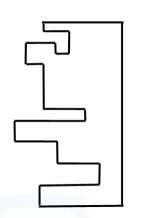
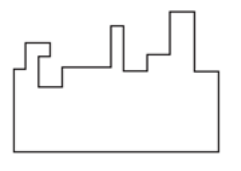
A jigsaw puzzle has 2 pieces. One of the pieces is shown. Which one of the given options for the missing piece when assembled will form a rectangle? The piece can be moved, rotated or flipped to assemble with the above piece.
Options
Correct Answer :
Solution :
To determine which piece completes the jigsaw puzzle to form a rectangle, we need to analyze the geometry of the given piece and find its complementary shape among the options.
The given puzzle piece in the question has:
1. A flat vertical right edge, a flat horizontal top edge, and a flat horizontal bottom edge. Together, these form three of the outer boundaries of the final rectangle.
2. An irregular left edge containing tabs (protrusions) and blanks (indentations).
3. Notably, near the top-left corner of the given piece, there is a distinct inward-facing "hook" shape containing a notch that goes down, right, down, left, up, left, and down.
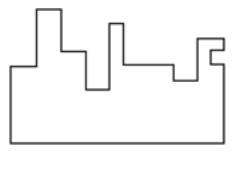
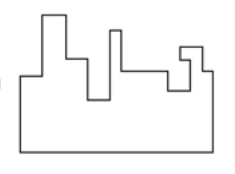
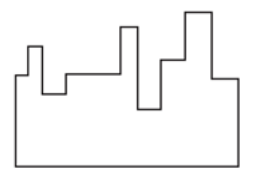
The options provided all have a flat bottom edge and a crenellated top edge.
- Option A: Has a hook-like protrusion on the right side, but the notch is simple and lacks the internal vertical step.
- Option B: Has a hook-like protrusion on the right side with the matching internal step/notch.
- Option C: Lacks the hook feature entirely (has only simple rectangular tabs).
- Option D: Has the hook-like protrusion on the left side.
To assemble Option B with the given piece to form a rectangle, we can apply the following transformations to the missing piece (Option B):
1. Rotate 90° Counter-Clockwise (CCW): This rotates the flat bottom edge to the right, and the top crenellated edge to the left. The hook feature (which was on the right) is now at the top of the left edge.
2. Flip Horizontally (Mirror): This reflects the piece horizontally, moving the flat right edge to the left side, while the crenellated left edge (with the hook at the top) moves to the right side to face the given piece.
Sliding the transformed Option B into the given piece aligns the hook on the top-right of the transformed piece with the hook on the top-left of the original piece, locking them together perfectly to form a solid rectangle with straight outer edges.
Thus, the correct option is the second one, which corresponds to Option B.
Access expert-curated educational resources and study materials—completely free.
Create, conduct, and manage professional online assessments with Mindyard. Perfect for teachers and institutes.
Copyright © 2026 Mindyard. All Rights Reserved.




