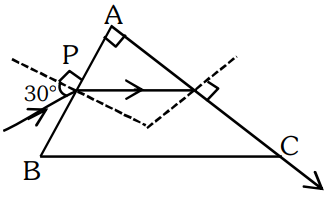
A light ray enters through a right angled prism at point P with the angle of incidence 30° as shown in figure. It travels through the prism parallel to its base BC and emerges along the face AC. The refractive index of the prism is:
Correct Answer :
Solution :
Based on the provided figure, the prism is a right-angled prism with the right angle at vertex (so the angle of the prism is ). The light ray enters face at point with an angle of incidence and emerges along the face , which means the angle of emergence is .
Let the refractive index of the prism be , the angle of refraction at the first face be , and the angle of incidence at the second face be .
Step 1: Apply Snell's Law at the first face (AB)
The ray enters from air (refractive index = 1) into the prism of refractive index :
Substituting :
Step 2: Relate the angles inside the prism
For a prism with refracting angle , the relationship between internal angles is:
Since the prism is right-angled at vertex , we have :
Therefore, the angle of incidence at the second face is:
Step 3: Apply Snell's Law at the second face (AC)
The ray emerges along the face , which means the angle of refraction in air is :
Using the trigonometric identity :
Step 4: Solve for the refractive index ()
Using the fundamental trigonometric identity:
Substitute the values from Steps 1 and 3:
Taking as the common denominator:
Taking the square root on both sides:
Access expert-curated educational resources and study materials—completely free.
Create, conduct, and manage professional online assessments with Mindyard. Perfect for teachers and institutes.
Copyright © 2026 Mindyard. All Rights Reserved.