(a) Meselson and Stahl carried out an experiment to prove the nature of DNA replication. Recall the experiment and answer the following questions.
i) Which two types of nitrogen were used by them in their experiment and why ?
ii) Why did they take samples of E. coli at definite time intervals for their observation ?
iii) State the role of caesium chloride density gradient in their experiment.
iv) Write the conclusions they arrived at.
or
(b)
i) A true breeding tall pea plant with round seeds is crossed with a recessive dwarf pea plant having wrinkled seeds. Work out the cross up to F₂ generation giving the phenotypic ratios of F₁ and F₂ generation respectively.
ii) State the Mendelian principle that can be derived only with the help of such a cross.
Correct Answer :
(a)
i) Normal nitrogen/ ¹⁴N, heavy nitrogen/¹⁵N to produce two types of DNA / light and heavy DNA respectively.
ii) E. coli has generation time of 20 minutes so the samples taken at intervals of 20 minutes, to understand the mode of replication when E.coli with ¹⁵N DNA was cultured in medium ¹⁴N (normal) nitrogen.
iii) To distinguish or separate heavy DNA from light DNA on the basis of density.
iv) Mode of DNA replication is semiconservative.
or
(b)
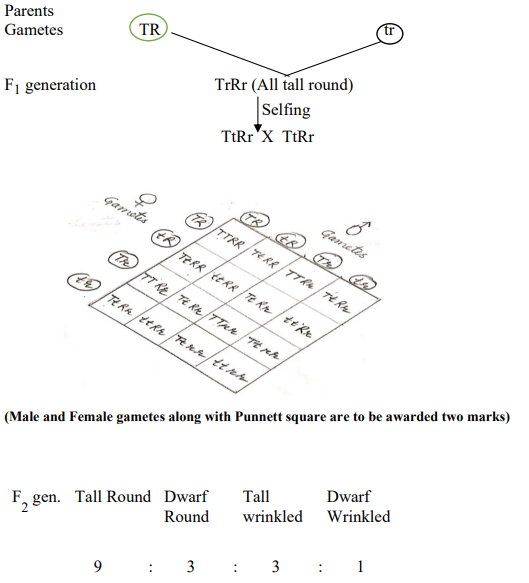
i) TTRR ttrr Tall round seeds Dwarf wrinkled seeds
(ii) ‘when two pairs of traits are combined in a hybrid, segregation of one pair of characters is independent of the other pair of characters’ (law of independent
assortment ).
Solution :
The provided correct answer explains the experimental details of the Meselson and Stahl experiment (part a) and the genetic principles of a dihybrid cross in pea plants (part b).
i) Nitrogen isotopes used:
Meselson and Stahl utilized two isotopes of nitrogen in their pioneering experiment: normal light nitrogen (14N) and heavy nitrogen (15N). 15N is a heavy isotope of nitrogen (not a radioactive isotope). These isotopes were incorporated into the nitrogenous bases of DNA as the E. coli cells divided. This allowed the researchers to synthesize and distinguish between two types of DNA: "light" DNA containing 14N and "heavy" DNA containing 15N.
ii) Reason for sampling at definite time intervals:
The bacterium Escherichia coli (E. coli) has a well-defined generation time of approximately 20 minutes under optimal laboratory conditions. By extracting DNA samples at specific 20-minute intervals (e.g., 20 minutes, 40 minutes, etc.) after transferring the bacteria from a 15N-containing medium to a 14N-containing medium, Meselson and Stahl could monitor the composition of the DNA helix in successive generations. This systematic timing was critical to tracking how the heavy parental strands were distributed among the new double helices, thereby revealing the semiconservative mode of replication.
iii) Role of Caesium Chloride (CsCl) density gradient centrifugation:
Caesium chloride density gradient centrifugation separates molecules strictly based on their buoyant densities. When centrifuged at high speeds, a CsCl solution forms a density gradient where the density increases from the top to the bottom of the tube. DNA containing the heavier isotope (15N-DNA) is denser and sedimented lower down in the gradient, while DNA containing the lighter isotope (14N-DNA) formed a band higher up. Hybrid DNA containing one strand of 15N and one of 14N settled exactly in the middle. This allowed the precise physical separation and identification of light, hybrid, and heavy DNA bands.
iv) Conclusions:
From their observations of the DNA bands over generations, Meselson and Stahl concluded that DNA replication is semiconservative. This means that during replication, the two strands of the parental double helix separate, and each serves as a template for the synthesis of a new complementary strand. Consequently, each daughter DNA molecule consists of one conserved parental strand and one newly synthesized strand.
i) Genetic Cross:
A true-breeding tall pea plant with round seeds (genotype TTRR) is crossed with a recessive dwarf pea plant having wrinkled seeds (genotype ttrr).
The parental cross and subsequent generation details can be traced as follows:
Parents: TTRR (Tall, Round) × ttrr (Dwarf, Wrinkled)
Gametes: The tall, round parent produces gametes with alleles TR (as labeled in the green circle in the provided image), and the dwarf, wrinkled parent produces gametes with alleles tr (labeled in the black circle in the image).
F1 Generation: Fertilization of these gametes yields the F1 generation with the heterozygous genotype TtRr. All F1 plants exhibit the dominant phenotype: Tall plants with round seeds.
Selfing of F1:
To produce the F2 generation, the F1 plants are self-pollinated:
TtRr × TtRr
During gamete formation in these F1 hybrids, four types of male and female gametes are produced in equal proportions: TR, tR, Tr, and tr.
These gametes are arranged in a 4 × 4 Punnett square, as shown in the handwritten diagram from the image, to determine the F2 genotypes:
| Gametes | TR | tR | Tr | tr |
|---|---|---|---|---|
| TR | TTRR | TtRR | TTRr | TtRr |
| tR | TtRR | ttRR | TtRr | ttRr |
| Tr | TTRr | TtRr | TTrr | Ttrr |
| tr | TtRr | ttRr | Ttrr | ttrr |
Phenotypic Ratio of F2 Generation:
Analysis of the Punnett square yields four distinct phenotypes in the classic dihybrid ratio:
• Tall, Round seeds: 9 plants (Genotypes: TTRR, TtRR, TTRr, TtRr)
• Dwarf, Round seeds: 3 plants (Genotypes: ttRR, ttRr)
• Tall, wrinkled seeds: 3 plants (Genotypes: TTrr, Ttrr)
• Dwarf, wrinkled seeds: 1 plant (Genotype: ttrr)
Therefore, the F2 phenotypic ratio visible at the bottom of the image is:
Tall Round : Dwarf Round : Tall wrinkled : Dwarf Wrinkled = 9 : 3 : 3 : 1
ii) Mendelian Principle derived:
The Mendelian principle that can be derived only with the help of a dihybrid cross (where two pairs of contrasting traits are studied simultaneously) is the Law of Independent Assortment. This law states that: "when two pairs of traits are combined in a hybrid, segregation of one pair of characters is independent of the other pair of characters." This leads to the formation of new parental and recombinant combinations in the offspring.
Access expert-curated educational resources and study materials—completely free.
Create, conduct, and manage professional online assessments with Mindyard. Perfect for teachers and institutes.
Copyright © 2026 Mindyard. All Rights Reserved.
 Set - 3-1782888548748.webp)