(a) Meselson and Stahl carried out an experiment to prove the nature of DNA replication. Recall the experiment and answer the following questions.
i) Which two types of nitrogen were used by them in their experiment and why?
ii) Why did they take samples of E. coli at definite time intervals for their observation?
iii) State the role of caesium chloride density gradient in their experiment. iv) Write the conclusions they arrived at.
or
(b)
i) A true breeding tall pea plant with round seeds is crossed with a recessive dwarf pea plant having wrinkled seeds. Work out the cross up to F2 generation giving the phenotypic ratios of F1 and F2 generation respectively.
ii) State the Mendelian principle that can be derived only with the help of such a cross.
Correct Answer :
(a)
i) Normal nitrogen/ 14N, heavy nitrogen/ 15N to produce two types of DNA / light and heavy DNA respectively.
ii) E. coli has generation time of 20 minutes so the samples taken at intervals of 20 minutes, to understand the mode of replication when E.coli with 15N DNA was cultured in medium 14N (normal) nitrogen.
iii) To distinguish or separate heavy DNA from light DNA on the basis of density.
iv) Mode of DNA replication is semiconservative.
or
(ii) ‘when two pairs of traits are combined in a hybrid, segregation of one pair of characters is independent of the other pair of characters’ (law of independent assortment ).
Solution :
Correct Answer/Option:
Part (a):
i) Normal nitrogen (14N) and heavy nitrogen (15N) to produce two types of DNA: light and heavy DNA respectively.
ii) E. coli has a generation time of 20 minutes, so samples were taken at intervals of 20 minutes to understand the mode of replication when E. coli with 15N DNA was cultured in a medium containing 14N (normal) nitrogen.
iii) The role of the caesium chloride (CsCl) density gradient is to distinguish or separate heavy DNA from light DNA on the basis of density.
iv) The conclusion is that the mode of DNA replication is semiconservative.
or
Part (b):
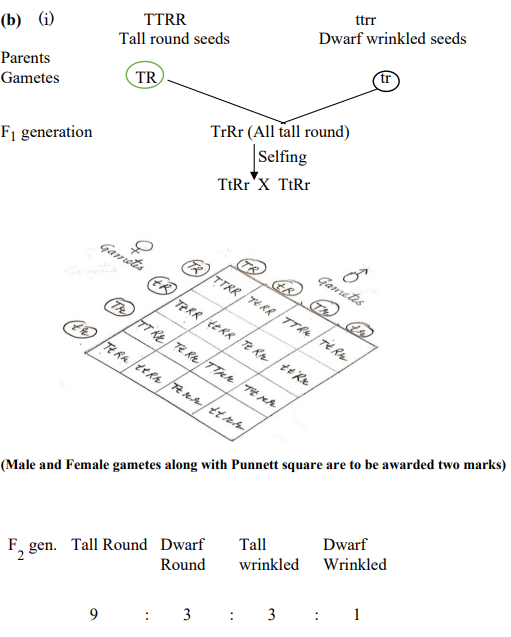
i) Refer to the cross and Punnett square representation below. The F1 phenotype is all Tall and Round, and the F2 phenotypic ratio is 9 : 3 : 3 : 1 (Tall Round : Dwarf Round : Tall Wrinkled : Dwarf Wrinkled).
ii) Law of Independent Assortment: "When two pairs of traits are combined in a hybrid, segregation of one pair of characters is independent of the other pair of characters."
Step-by-Step Educational Explanation:
Section A: Meselson and Stahl's Experiment
i) Nitrogen Isotopes Used: Matthew Meselson and Franklin Stahl used normal light nitrogen (14N) and the heavy isotope of nitrogen (15N). By growing E. coli in media containing these distinct isotopes, the nitrogen was incorporated into the newly synthesized purine and pyrimidine bases of DNA. Because 15N has an extra neutron, it is physically heavier than 14N, allowing the researchers to distinguish between "heavy" and "light" DNA strands based on mass.
ii) Sampling Interval: The generation time (cell division cycle) of E. coli is approximately 20 minutes under optimal growth conditions. By extracting samples at regular 20-minute intervals (representing successive generations), Meselson and Stahl could monitor the distribution of the heavy (15N) parental DNA strands and light (14N) newly synthesized DNA strands across generations.
iii) Caesium Chloride (CsCl) Density Gradient Centrifugation: When centrifuged at very high speeds, CsCl forms a continuous density gradient from the top to the bottom of the tube. DNA molecules migrate to the position in the tube where their density matches the density of the surrounding CsCl solution. This high-resolution separation technique allowed the scientists to clearly distinguish three distinct bands of DNA: heavy (15N-15N), hybrid (15N-14N), and light (14N-14N).
iv) Conclusions: Since the DNA isolated from the first generation (at 20 minutes) was entirely of hybrid density, and the second generation (at 40 minutes) consisted of equal amounts of hybrid and light DNA, they concluded that DNA replication is semiconservative. That is, each replicated DNA molecule contains one original template strand and one newly synthesized strand.
Section B: Dihybrid Cross in Pea Plants
i) Working out the Cross:
Based on the genetic cross scheme shown in the provided image:
• Parents: Tall, Round (Genotype: TTRR) × Dwarf, Wrinkled (Genotype: ttrr)
• Gametes: The parent TTRR produces gametes containing the alleles TR, while the parent ttrr produces gametes containing the alleles tr.
F1 Generation:
Fusing the gametes TR and tr produces the F1 hybrid genotype TtRr. Because tallness (T) and round seed shape (R) are dominant over dwarfness (t) and wrinkled seed shape (r), the phenotype of all F1 individuals is Tall and Round.
F2 Generation (Selfing of F1):
When F1 plants (TtRr) are self-pollinated, they produce four types of gametes with equal probability: TR, tR, Tr, and tr. As depicted in the Punnett square in the image:
• Female gametes (down the left column): TR, tR, Tr, tr
• Male gametes (across the top row): TR, tR, Tr, tr
Combining these gametes yields the 16 combinations shown in the square:
• Row 1: TTRR, TtRR, TTRr, TtRr
• Row 2: TtRR, ttRR, TtRr, ttRr
• Row 3: TTRr, TtRr, TTrr, Ttrr
• Row 4: TtRr, ttRr, Ttrr, ttrr
Counting the phenotypes of these 16 combinations gives:
• Tall Round: 9 offspring (genotypes: TTRR, TtRR, TTRr, TtRr)
• Dwarf Round: 3 offspring (genotypes: ttRR, ttRr)
• Tall Wrinkled: 3 offspring (genotypes: TTrr, Ttrr)
• Dwarf Wrinkled: 1 offspring (genotype: ttrr)
This gives the F2 phenotypic ratio of 9 : 3 : 3 : 1.
ii) Mendelian Principle:
This dihybrid cross demonstrates Mendel's Law of Independent Assortment. This law states that when two pairs of traits are combined in a hybrid, the segregation of one pair of characters during gamete formation is completely independent of the other pair, allowing for new combinations of traits to appear in the offspring.
Access expert-curated educational resources and study materials—completely free.
Create, conduct, and manage professional online assessments with Mindyard. Perfect for teachers and institutes.
Copyright © 2026 Mindyard. All Rights Reserved.
 Set - 3-1782888548748.webp)