A monochromatic light wave is incident normally on a glass slab of thickness d, as shown in the figure. The refractive index of the slab increases linearly from n1 to n2 over the height h. Which of the following statements is/are true about the light wave emerging out of the slab?
Consider the 6 x 6 square in the figure. Let A1, A2, ..., A49 be the points of intersections
(dots in the picture) in some order. We say that A and A are friends if they are adjacent
along a row or along a column. Assume that each point A has an equal chance of being
chosen.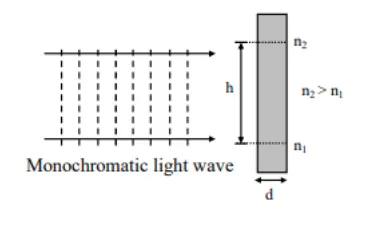
Correct Answer :
It will deflect up by an angle
The deflection angle depends only on n2 − n1 and not on the individual values of n1 and n2.
Solution :
Correct Options:
1. It will deflect up by an angle
2. The deflection angle depends only on n2 − n1 and not on the individual values of n1 and n2.
Step-by-step Explanation:
1. Understanding the Physical System:
As shown in the figure:
A plane, monochromatic light wave with vertical wavefronts is incident normally from the left onto a glass slab of thickness d and height h. The refractive index of the slab increases linearly from n1 at the bottom to n2 at the top (where n2 > n1).
2. Optical Path Difference Across the Height:
The optical path traveled by light through the slab at any height y is given by:
At the bottom boundary (y = 0), the refractive index is n1, so the optical path length is:
At the top boundary (y = h), the refractive index is n2, so the optical path length is:
3. Phase Difference and Tilt of the Wavefront:
Since n2 > n1, the light wave at the top travels through a higher optical path and therefore suffers a greater effective retardation/delay compared to the light ray at the bottom.
The total optical path difference between the top ray and the bottom ray upon emerging from the slab is:
4. Calculating the Angle of Deflection (θ):
Because the wavefront tilts by a spatial path displacement of Δx over a total transverse height h, the emerging wavefront is tilted at an angle θ relative to the vertical.
Since rays propagate perpendicular to the wavefronts, the direction of propagation tilts upward by the exact same angle θ:
Taking the inverse tangent on both sides gives:
5. Analyzing Dependence:
From the formula derived above, the deflection angle θ depends directly on the difference (n2 − n1), thickness d, and height h. It does not depend independently on the individual baseline refractive index values of n1 or n2.
Thus, both correct statements are:
• It will deflect up by an angle .
• The deflection angle depends only on n2 − n1 and not on the individual values of n1 and n2.
Access expert-curated educational resources and study materials—completely free.
Create, conduct, and manage professional online assessments with Mindyard. Perfect for teachers and institutes.
Copyright © 2026 Mindyard. All Rights Reserved.