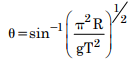
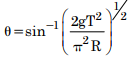
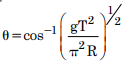
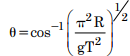
A particle moving in a circle of radius R with a uniform speed takes a time T to complete one revolution. If this particle were projected with the same speed at an angle ‘θ’ to the horizontal, the maximum height attained by it equals 4R. The angle of projection, θ, is then given by :
Options
Correct Answer :
Solution :
The correct option is:
Step-by-Step Derivation:
Step 1: Determine the speed of the particle in circular motion
A particle moving in a circle of radius R at a uniform speed v completes one full revolution of distance in time T.
Therefore, the speed v is given by:
Step 2: Relate speed to the maximum height in projectile motion
When the particle is projected with the same speed v at an angle θ to the horizontal, the maximum height H attained by the projectile is:
Given that the maximum height attained is , we substitute this value into the equation:
Step 3: Substitute the expression for v
Squaring the expression for v from Step 1 gives:
Substituting into the height equation:
Step 4: Solve for sinθ and angle θ
Canceling 4 and one power of R from both sides:
Rearranging terms to isolate :
Taking the square root on both sides gives:
Thus, the angle of projection θ is:
Access expert-curated educational resources and study materials—completely free.
Create, conduct, and manage professional online assessments with Mindyard. Perfect for teachers and institutes.
Copyright © 2026 Mindyard. All Rights Reserved.