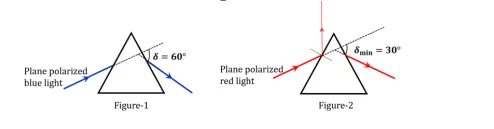
A plane polarized blue light ray is incident on a prism such that there is no reflection from the surface of the prism. The angle of deviation of the emergent ray is δ = 60° (see Figure-1). The angle of minimum deviation for red light from the same prism is δmin = 30° (see Figure-2). The refractive index of the prism material for blue light is √3
 .
.
Which of the following statement(s) is(are) correct?
Correct Answer :
The blue light is polarized in the plane of incidence.
The refractive index of the material of the prism for red light is .
The angle of refraction for blue light in air at the exit plane of the prism is 60°.
Solution :
Correct Statements:
• The blue light is polarized in the plane of incidence.
• The refractive index of the material of the prism for red light is .
• The angle of refraction for blue light in air at the exit plane of the prism is 60°.
Step-by-step Explanation:
1. Polarization of Blue Light and Brewster's Law:
From the problem description and Figure-1, when a plane-polarized blue light ray is incident on the first surface of the prism, there is no reflection. This occurs when light is incident at Brewster's angle () and the electric field vectors lie entirely within the plane of incidence (p-polarized light). Therefore, the blue light is polarized in the plane of incidence.
According to Brewster's Law, the angle of incidence for blue light is given by:
The angle of refraction inside the prism at the first surface is:
2. Angle of the Prism () and Emergent Angle for Blue Light ():
The deviation of light through a prism is given by:
Given for blue light:
Using Snell's law at the emergent surface for blue light:
Since , we have . Substituting :
Thus, the angle of the prism is , and the angle of refraction (emergence angle) for blue light in air at the exit plane of the prism is .
3. Refractive Index for Red Light:
From Figure-2, the angle of minimum deviation for red light is .
The relation between refractive index , angle of prism , and minimum deviation is:
Substituting and :
Therefore, the refractive index of the material of the prism for red light is .
Access expert-curated educational resources and study materials—completely free.
Create, conduct, and manage professional online assessments with Mindyard. Perfect for teachers and institutes.
Copyright © 2026 Mindyard. All Rights Reserved.