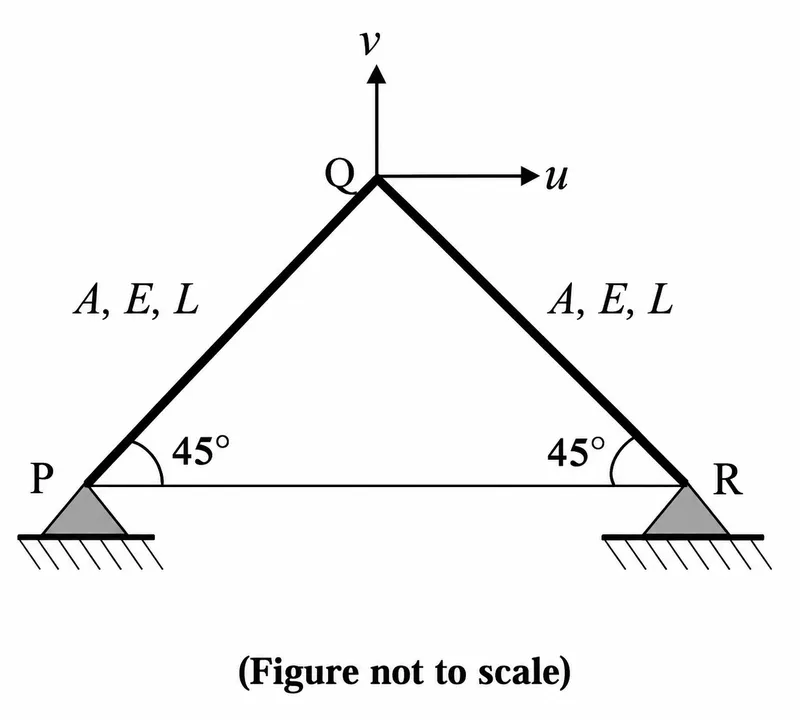
A plane truss consists of two linearly elastic, homogeneous, identical members, namely PQ and QR. Both members have length (L), cross-sectional area (A), and modulus of elasticity (E). The members are inclined at 45◦ as shown in the figure. The truss has hinge supports at P and R. The translational degrees-of-freedom (u and v) are shown at joint Q. After application of the boundary conditions, the stiffness matrix of the truss becomes:
Correct Answer :
Solution :
The correct stiffness matrix of the truss after the application of the boundary conditions is:
Step-by-Step Derivation and Analysis:
1. Identify the Boundary Conditions and Active Degrees of Freedom:
As shown in the truss diagram, joints P and R are fixed hinge supports. Since they are constrained in both the horizontal and vertical directions, their displacement degrees of freedom are zero:
and
Consequently, the only free coordinates (active degrees of freedom) in the entire truss system are the horizontal displacement and the vertical displacement at joint Q. Thus, the reduced stiffness matrix of the structure corresponds to the joint Q and has a size of 2 × 2.
2. General Element Stiffness Contribution:
For a plane truss member of length , cross-sectional area , and modulus of elasticity , oriented at an angle relative to the positive horizontal axis, the stiffness matrix contribution to the displacements at one of its nodes is given by:
3. Compute Stiffness Contribution of Member PQ:
Member PQ has length and is inclined at an angle of relative to the horizontal line connecting P and R.
Using:
and
We get:
Substituting these values, the stiffness contribution of PQ at joint Q is:
4. Compute Stiffness Contribution of Member QR:
Member QR is inclined at an angle of relative to the horizontal PR at support R. If we orient the member vector pointing from support R to joint Q, its direction angle is:
Using:
and
We obtain:
Substituting these values, the stiffness contribution of QR at joint Q is:
5. Structural Stiffness Matrix Assembly:
The structural stiffness matrix for the active degrees of freedom and is assembled by summing the contributions from both member PQ and member QR:
Access expert-curated educational resources and study materials—completely free.
Create, conduct, and manage professional online assessments with Mindyard. Perfect for teachers and institutes.
Copyright © 2026 Mindyard. All Rights Reserved.