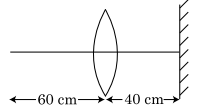
A point object is placed at a distance of 60 cm from a convex lens of focal length 30 cm. If a plane mirror were put perpendicular to the principal axis of the lens and at a distance of 40 cm from it, the final image would be formed at a distance of :
Correct Answer :
20 cm from the plane mirror, it would be a virtual image.
Solution :
The diagram (shown in the attached image) depicts a convex lens L of focal length f = 30 cm. An object O is placed 60 cm to the left of the lens. A plane mirror M is positioned 40 cm to the right of the lens, with its reflective surface perpendicular to the principal axis.
**1. First image formed by the lens**
Using the thin‑lens formula
where
**2. Object for the plane mirror**
The plane mirror is 40 cm from the lens, so the distance between I₁ and the mirror is
Hence I₁ acts as a real object for the mirror at a distance of 20 cm in front of it.
**3. Image formed by the plane mirror**
For a plane mirror, the image distance equals the object distance and lies behind the mirror. Therefore the mirror creates a virtual image I₂ that is
behind the mirror (on the same side as the lens).
**4. Second passage through the lens**
The light reflected from the mirror now travels leftward toward the lens. The virtual image I₂, situated 20 cm behind the mirror, is therefore 20 cm to the right of the lens. This acts as a **new object** for the lens on the side from which light is incident.
For this second encounter the object distance (measured from the lens on the incident side) is (the object is on the same side as the incoming light, so we treat it as positive). Using the thin‑lens formula again: Hence The negative sign indicates that the final image is virtual and forms on the same side of the lens as the incoming light, i.e., on the right‑hand side of the lens.
**5. Position relative to the plane mirror**
The lens‑to‑mirror separation is 40 cm. A virtual image 60 cm to the right of the lens lies
beyond the plane mirror. Consequently the final image is located **20 cm behind the plane mirror** and is virtual.
Therefore, the correct choice is: **20 cm from the plane mirror, it would be a virtual image.**
Access expert-curated educational resources and study materials—completely free.
Create, conduct, and manage professional online assessments with Mindyard. Perfect for teachers and institutes.
Copyright © 2026 Mindyard. All Rights Reserved.