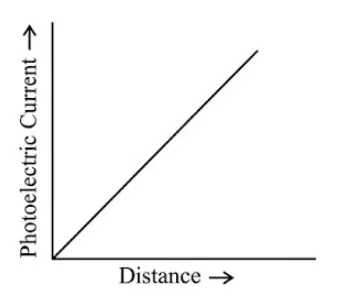
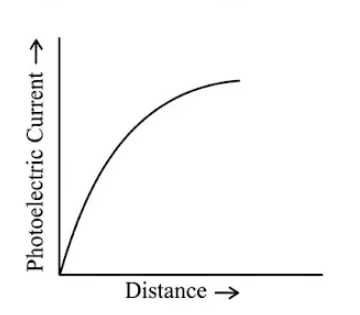
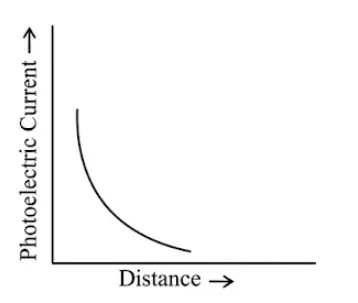
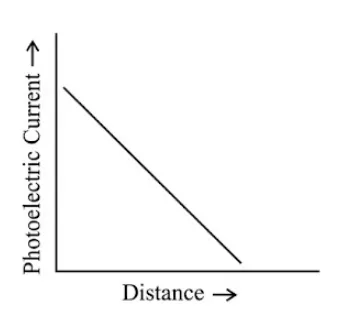
A point source causing photoelectric emission from a metallic plate is moved away from the plate. The variation of photoelectric current with distance from the source is correctly represented by the graph ______.
Options
Correct Answer :
Solution :
The correct answer is represented by the third graph (Option 3 / Image 2), which shows a non-linear (hyperbolic) decrease of photoelectric current with distance. In this graph, the vertical axis is labeled "Photoelectric Current" and the horizontal axis is labeled "Distance". As distance increases, the curve falls sharply towards the horizontal axis.
To understand why this graph is correct, we can analyze the relationship between the distance of the point source and the resulting photoelectric current step-by-step:
First, for a point source of light, the intensity of light () falling on the metallic plate follows the inverse-square law. This means the intensity is inversely proportional to the square of the distance () from the source to the plate:
Second, the photoelectric current () is directly proportional to the number of photoelectrons emitted per second, which in turn is directly proportional to the intensity () of the incident light:
By combining these two relationships, we find that the photoelectric current () is inversely proportional to the square of the distance ():
This mathematical relationship indicates that when the point source is very close to the metallic plate, the photoelectric current is high. As the source is moved further away (distance increases), the photoelectric current decreases rapidly in a non-linear, hyperbolic fashion, asymptotically approaching zero. This is correctly represented by the curve shown in the third graph.
Access expert-curated educational resources and study materials—completely free.
Create, conduct, and manage professional online assessments with Mindyard. Perfect for teachers and institutes.
Copyright © 2026 Mindyard. All Rights Reserved.