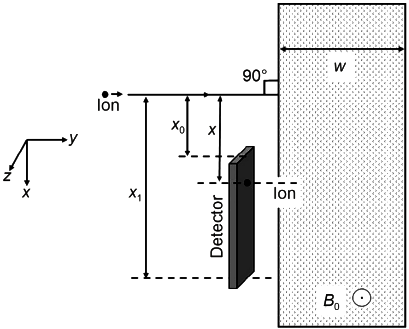
A positive, singly ionized atom of mass number 𝐴M is accelerated from rest by the voltage 192 V. Thereafter, it enters a rectangular region of width 𝑤 with magnetic field Tesla, as shown in the figure. The ion finally hits a detector at the distance 𝑥 below its starting trajectory.
[Given: Mass of neutron/proton = (5/3) × 10−27 kg, charge of the electron = 1.6 × 10⁻¹⁹ C.]
Which of the following option(s) is(are) correct?
Correct Answer :
The value of 𝑥 for 𝐻+ ion is 4 cm
The value of 𝑥 for an ion with 𝐴M = 144 is 48 cm.
The value of 𝑥 for 𝐻+ ion is 4 cm; The value of 𝑥 for an ion with 𝐴M = 144 is 48 cm.
Solution :
1. Relation between acceleration potential and kinetic energy:
Let the mass of the singly ionized atom be and its charge be .
The ion starts from rest and is accelerated through a potential difference . The kinetic energy gained by the ion is:
where is the velocity of the ion when entering the magnetic field.
The momentum is therefore given by:
2. Motion in the magnetic field:
As shown in the image, the ion enters the rectangular magnetic field region of width perpendicularly (at to the boundary).
The magnetic field is given as (pointing out of the page).
The magnetic force acts perpendicular to both velocity and the field. For a positive ion traveling in the +y direction into a field along the +z direction, the cross product points downwards (in the +x direction).
This constant perpendicular force deflects the ion into a circular arc of radius , where:
3. Calculating the deflection distance:
From the geometry in the diagram, the ion turns by and exits back through the left boundary, hitting the detector.
The vertical deflection below its entry level is equal to the diameter of the circular path:
4. Substituting the numerical values:
Let the mass number of the ion be . The mass of the ion is:
Using , , and :
Simplifying the term inside the square root:
For the powers of 10:
Thus:
Converting this to centimeters:
5. Verifying the correct options:
- For ion, the mass number is :
This makes the first option correct.
- For an ion with :
This makes the second option correct.
Access expert-curated educational resources and study materials—completely free.
Create, conduct, and manage professional online assessments with Mindyard. Perfect for teachers and institutes.
Copyright © 2026 Mindyard. All Rights Reserved.