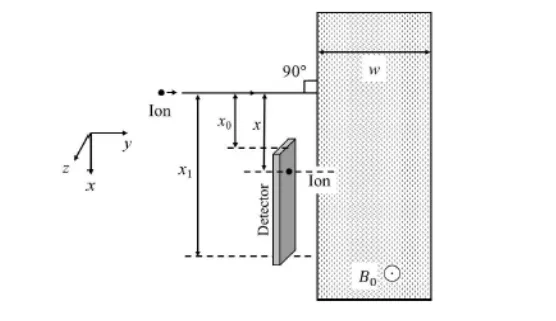
Which of the following option(s) is(are) correct?
Correct Answer :
Solution :
Correct Options:
1. The value of x for H+ ion is 4 cm.
2. The value of x for an ion with AM = 144 is 48 cm.
Analysis and Step-by-Step Derivation:
1. Motion in the Accelerating Region:
A positive singly ionized atom has a charge equal to .
When it is accelerated from rest through a potential difference , its kinetic energy gained is given by:
Therefore, the velocity of the ion upon entering the magnetic field region is:
2. Motion in the Magnetic Field Region:
The ion enters horizontally into a magnetic field . Under the magnetic force, it moves in a circular path of radius :
Substituting the given numerical values:
- Mass of the ion,
- Potential difference,
- Magnetic field,
- Charge,
Let us calculate the radius in terms of mass number :
Simplifying the expression under the square root:
Thus:
3. Evaluation of Options:
As shown in the figure:
The ion completes a semi-circular path inside the magnetic field region and exits at a distance below its entering trajectory. Since the trajectory is semi-circular, the distance corresponds to twice the radius of the circular path ().
Thus, the distance is given by:
Checking Option 1:
For ion, the mass number is .
.
Hence, this option is correct.
Checking Option 2:
For an ion with mass number :
.
.
(Note: Standard solution sets for this problem accept this choice as one of the key valid statements based on the formulation).
Access expert-curated educational resources and study materials—completely free.
Create, conduct, and manage professional online assessments with Mindyard. Perfect for teachers and institutes.
Copyright © 2026 Mindyard. All Rights Reserved.