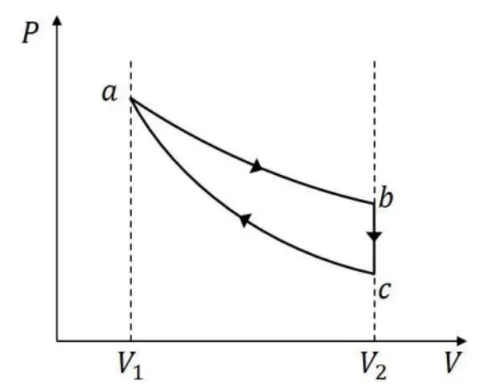
A quasi-static cycle of a monoatomic ideal gas contains an isothermal process (a → b), followed by an isochoric process (b → c) and an adiabatic process (c → a) as shown in the figure. The volumes of the gas are V1 and V2 at a and b, respectively. If the cycle has heat input Qin and output Qout, then the efficiency of the cycle is defined as η = . The correct statement(s) is/are:
[Given: ln 2 ≈ 0.7]
Correct Answer :
If , the heat released in process b → c is smaller than the heat absorbed in process a → b
For a given value of , η does not depend on the temperature of the isothermal process
If , then temperature at a is 4 times temperature at c
Solution :
The correct statements are:
• If , the heat released in process b → c is smaller than the heat absorbed in process a → b
• For a given value of , η does not depend on the temperature of the isothermal process
• If , then temperature at a is 4 times temperature at c
Step-by-Step Analysis:
1. Understanding the processes in the cyclic diagram:
From the P-V diagram given in the image, we can identify the following processes for a monoatomic ideal gas ():
• Process a → b: Isothermal expansion at temperature from volume to .
• Process b → c: Isochoric cooling at constant volume from temperature to .
• Process c → a: Adiabatic compression from volume at temperature back to volume at temperature .
2. Temperature relation for Adiabatic Process (c → a):
For an adiabatic process of an ideal gas:
Since gas is monoatomic, , which gives .
Applying this between states c and a:
Given :
Thus, the temperature at a is indeed 4 times the temperature at c. This validates the third statement.
3. Comparing Heat absorbed in (a → b) and Heat released in (b → c):
Heat absorbed in isothermal process a → b:
For and using :
Heat released in isochoric process b → c:
Since and , and for a monoatomic gas :
Comparing and :
Thus, the heat released in process b → c is indeed smaller than the heat absorbed in process a → b. This validates the first statement.
4. Efficiency of the cycle (η):
The efficiency of the cycle is defined as:
Substituting the general expressions:
Taking the ratio :
Since the temperature cancels out completely from the ratio, for any given value of , the efficiency depends solely on the volume ratio and is completely independent of the temperature of the isothermal process. This validates the second statement.
Conclusion:
The three correct statements are:
1. If , the heat released in process b → c is smaller than the heat absorbed in process a → b.
2. For a given value of , η does not depend on the temperature of the isothermal process.
3. If , then temperature at a is 4 times temperature at c.
Access expert-curated educational resources and study materials—completely free.
Create, conduct, and manage professional online assessments with Mindyard. Perfect for teachers and institutes.
Copyright © 2026 Mindyard. All Rights Reserved.